
The Multiplayer Mode of DevOps: How CI Orchestrates Distributed Teams
Stop integration hell. Learn how Continuous Integration acts as an automated mediator for distributed DevOps teams working across multiple time zones.
format_list_bulleted
Table of Contents
6 sections
expand_more
This is the part 4 of CICD deep dive series:
- Part 1: Breaking the "Box" Myth: Why CI/CD is a Pipeline, Not a Single Tool
- Part 2: From Laptop to Live: Why CI/CD is the Beating Heart of Modern DevOps
- Part 3: Containerizing the Build: The Engine Inside Your CI/CD Pipeline
In part 3, we looked at how containerizing your build process provides a "clean room" that eliminates the dreaded "it works on my machine" problem. Containers ensure the environment is consistent.
But what happens when the code isn't?
Modern software is rarely built by a single developer sitting in a dark room. It is built by distributed teams. You might have a developer in London optimizing a Go microservice, another in Tokyo updating a Ruby on Rails backend, and a third in New York writing Python data scripts.
When multiple people are modifying the same codebase simultaneously, you run headfirst into a classic engineering nightmare: Integration Hell. Here is how Continuous Integration (CI) solves this problem and acts as the automated mediator for distributed teams.
The Problem: Integration Hell and Asynchronous Chaos#
Imagine a world without CI. Developer A finishes a feature and merges it into the main codebase. Twelve hours later, Developer B wakes up, finishes their feature, and merges it.
Suddenly, the application won't boot. Developer A changed a core function that Developer B was relying on. Because they are in different time zones, they couldn't communicate the change in real-time. Now, the main branch is broken, everyone is blocked from deploying, and hours will be wasted untangling the conflicting code.
This is Integration Hell. When a distributed team manually integrates large batches of code infrequently, the risk of catastrophic conflicts skyrockets.
The Solution: CI as the Automated Mediator#
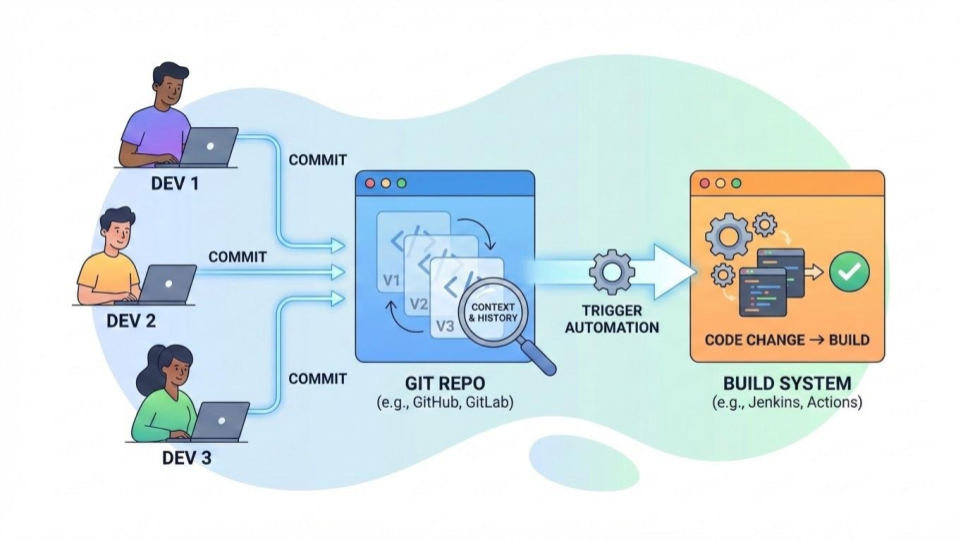
Continuous Integration forces a fundamental shift in behavior: instead of integrating code once a month, developers integrate code multiple times a day in small, easily verifiable batches.
For a distributed team, the CI pipeline becomes the single source of truth. It doesn't matter what time zone you are in; the CI pipeline enforces the rules of the road automatically.
Here is how that workflow operates in a healthy distributed team:
1. The Feature Branch and the Pull Request (PR)#
When a developer starts working on a new feature, they don't push directly to the main production branch. They create an isolated "feature branch." When they are finished, they open a Pull Request (or Merge Request). This is essentially asking the team: "I would like to merge this new code into the main application. Please review."
2. The Automated Interrogation (The CI Pipeline)#
The second that PR is opened, the CI pipeline wakes up. Before a human ever looks at the code, the CI runner acts as an automated gatekeeper. It checks out the new code and subjects it to a battery of tests:
- Code Formatting and Linting: Does this code meet the team's style guidelines? (e.g., running
rubocopfor Ruby orflake8for Python). This prevents silly arguments over spaces versus tabs. - Unit and Integration Testing: Does this new feature actually work? More importantly, did it break any existing features? The CI pipeline runs the entire automated test suite.
- Security Scanning: Are there any known vulnerabilities in the new open-source dependencies the developer just added?
3. The Human Review (Asynchronous Collaboration)#
Only after the CI pipeline glows green (meaning all tests passed) does the human review begin.
Because the CI pipeline has already verified that the code is structurally sound, formatted correctly, and doesn't break existing tests, the human reviewer can focus on the actual logic and architecture. They don't have to waste time checking for syntax errors.
If the developer in Tokyo opens a PR at the end of their day, the CI pipeline tests it immediately. When the reviewer in London wakes up, they see a PR with a green checkmark, review the logic, and click "Merge." Zero real-time coordination was required.
The Real Value: Confidence at Scale#
For a distributed team, the true value of CI is confidence.
Without CI, pushing code is an anxiety-inducing event. With a robust CI pipeline, a new developer can join the team on a Monday, write a small bug fix on Tuesday, and open a PR with absolute confidence. They know that if they made a mistake, the automated tests will catch it before it ever impacts a customer.
CI transforms the Git repository from a chaotic filing cabinet into a highly orchestrated assembly line, allowing teams to work together seamlessly, no matter where they are in the world.

Indika Kodagoda
Indika Kodagoda is a Lead DevOps Engineer, AWS certification instructor, and the creator of CloudQubes. He specializes in cloud infrastructure, automation, and modern Ruby on Rails development. When he’s not deploying code or mentoring aspiring engineers, he’s usually enjoying nature and cycling local gravel paths.