
From Laptop to Live: Why CI/CD is the Beating Heart of Modern DevOps
Discover why CI/CD is the beating heart of modern DevOps. Learn how automated pipelines safely bridge the gap between a developer's laptop and live production.
format_list_bulleted
Table of Contents
4 sections
expand_more
In our previous post, we broke down a common misconception: CI/CD is not a single, magical "box" sitting in a server rack. It is a distributed, event-driven pipeline.
But why go through the trouble of building this pipeline in the first place? What exactly is flowing through it, and why has it become the absolute mandatory standard for any modern DevOps team?
To understand the why, we first have to look at the what. We have to look at the perilous journey of getting code out of a developer's head and into the hands of a user.
The Journey: From localhost to Production#
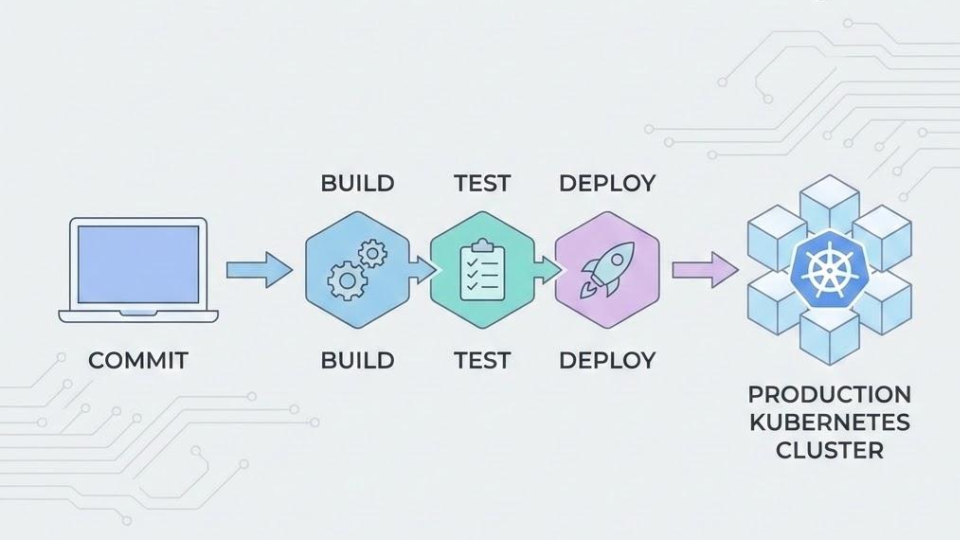
Imagine you have just finished writing a brilliant new feature. You’ve spun up your local environment—perhaps using a tool like Podman—your web framework (say, a Ruby on Rails application) is humming along perfectly on localhost, and your local tests are green.
It works on your machine. But "your machine" doesn't serve customers.
The fundamental job of a CI/CD pipeline is to safely, reliably, and automatically bridge the massive gap between a developer's laptop and the live production environment.
Here is how the pipeline breaks down that journey:
- Continuous Integration (CI): The Validator. As soon as you push your code to a repository, the CI process kicks in. It takes your code, merges it with everyone else's code, and aggressively tests it. It builds the application from scratch in an isolated environment to definitively prove: Yes, this code still works when it's not on the original developer's laptop.
- Continuous Delivery (CD): The Transporter. Once the code is proven stable, CD takes over. It packages the application into a deployable artifact (like a container image) and stages it. It ensures that the software is always in a state where it could be deployed to an environment like AWS at the push of a button.
- Continuous Deployment (CD): The Automator. Taking it one step further, Continuous Deployment removes the human entirely. If the code passes all CI tests, it is automatically pushed into the live production environment without manual intervention.
The Dark Ages: Why We Needed a Better Way#
To understand why CI/CD is required, you have to remember how painful software deployment used to be.
Before CI/CD, moving code to production was a high-risk, manual chore. A developer would finish a feature, bundle up the files, and hand them off to a SysAdmin. That SysAdmin would SSH into a live server, manually upload files, run database migration scripts by hand, and pray the server didn't crash.
This manual approach caused massive bottlenecks:
- "It Works on My Machine" Syndrome: Dependencies on a developer's laptop rarely matched the production server exactly, leading to unexpected crashes.
- Infrequent Deployments: Because deploying was painful and risky, teams only did it once a month or once a quarter.
- Massive Blast Radiuses: When you deploy three months' worth of code all at once, something is guaranteed to break, and figuring out which specific line of code caused the outage is nearly impossible.
Why CI/CD is Mandatory in Modern DevOps#
Today, you cannot do cloud engineering without CI/CD. It is the dividing line between legacy IT and modern DevOps. Here is why it is strictly mandatory:
1. Speed and Market Agility#
Modern businesses cannot wait three months to release a feature. CI/CD allows teams to deploy small, incremental changes multiple times a day. If a competitor launches a new feature, a DevOps team with a robust pipeline can respond in hours, not weeks.
2. Risk Reduction Through Automation#
Humans are terrible at doing the exact same sequence of complex tasks repeatedly without making a mistake. Scripts and pipelines do it perfectly every single time. By automating the testing and deployment, you remove the human error of a missed configuration or a forgotten database migration.
3. Faster Mean Time to Recovery (MTTR)#
Because CI/CD encourages deploying very small batches of code, when something does break in production, the blast radius is tiny. You know exactly which small commit caused the issue, and your pipeline allows you to instantly roll back to the previous stable version or push a hotfix in minutes.
4. Developer Sanity#
Developers want to write code, not wrestle with servers. A robust CI/CD pipeline acts as a safety net. It gives developers the confidence to experiment and push code, knowing the automated tests will catch their mistakes before they ever reach a customer.
The Bottom Line#
A CI/CD pipeline is the central nervous system of a DevOps culture. It transforms software delivery from a terrifying, manual, late-night ordeal into a boring, automated, everyday routine. And in cloud engineering, "boring" deployments are exactly what you want.

Indika Kodagoda
Indika Kodagoda is a Lead DevOps Engineer, AWS certification instructor, and the creator of CloudQubes. He specializes in cloud infrastructure, automation, and modern Ruby on Rails development. When he’s not deploying code or mentoring aspiring engineers, he’s usually enjoying nature and cycling local gravel paths.