
Breaking the "Box" Myth: Why CI/CD is a Pipeline, Not a Single Tool
Transitioning to DevOps? Learn why CI/CD is a distributed pipeline, not a centralized box. Explore the journey from Git to Kubernetes in this CloudQubes guide.
format_list_bulleted
Table of Contents
3 sections
expand_more
If you are transitioning into cloud engineering from a traditional IT background—whether that’s network engineering, system administration, or database management—you are likely used to working with "boxes."
A router is a box. A firewall is a box. A database server is a box. You assign it an IP address, you log into its management interface, you configure it, and it does its job.
New DevOps engineers trying to comprehend the Continuous Integration and Continuous Deployment (CI/CD), naturally tend to look for this type of a box. They look for the single piece of software or the centralized server they can log into to "do the CI/CD."
And they get baffled by the absence of such a box.
The CI/CD pipeline, as the name itself implies, isn't a box. It is a distributed, event-driven pipeline. If you try to force it into a centralized mental model, the architecture will never quite make sense. Here is why the "centralized box" approach fails, and how you should think about CI/CD instead.
Why a Centralized "Box" Doesn't Work#
Imagine you have a single, centralized "CI/CD Server" sitting in your environment. Its job is to take new code and deploy it.
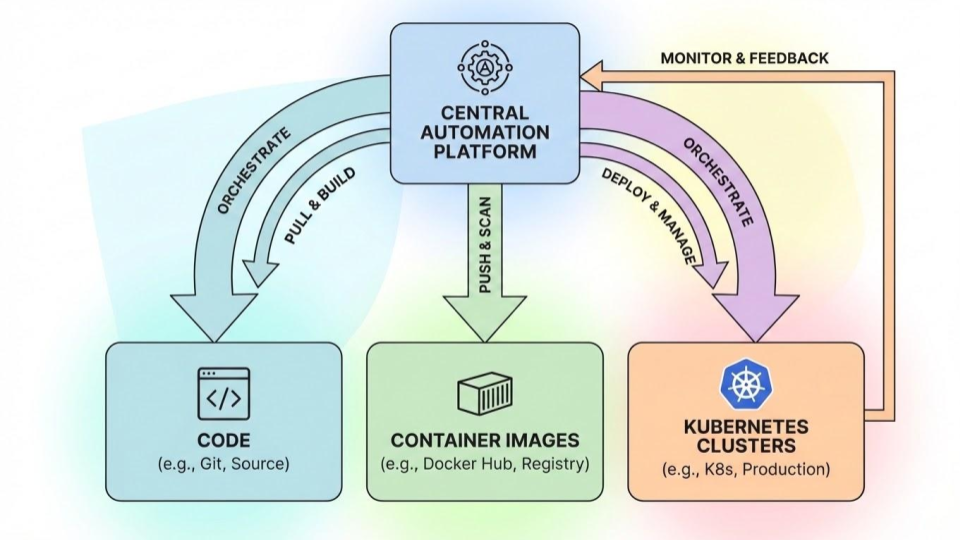
The immediate problem is one of awareness and context. Code changes happen dynamically on individual developers' laptops. A static, centralized server has no idea when a developer hits "save" or finishes a feature. To find out, it would have to constantly poll every developer's machine or wait for a manual upload—a slow, fragile, and unscalable process.
Furthermore, building software requires specific environments, dependencies, and testing frameworks. Deploying software requires access to production environments, like a Kubernetes cluster. A single box trying to manage the context of the source code, the compute resources to build it, and the security credentials to deploy it quickly becomes a massive, insecure bottleneck.
The Distributed Reality: Event-Driven Workflows#
Instead of a single appliance, modern CI/CD is a chain of specialized tools reacting to events. The pipeline moves the software from the developer's local environment to production, handing off responsibilities at each stage.
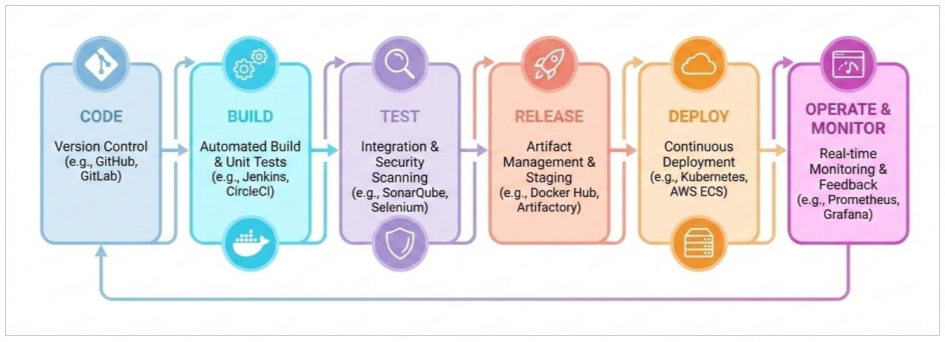
Here is what that distributed nature actually looks like in practice:
1. The Trigger: The Git Repository#
The pipeline doesn't start at a central CI server; it starts where the code lives. When a developer finishes a feature on their laptop, they push that code to a remote Git repository (like GitHub or GitLab).
- The Role: Git is the only system fully aware of state changes. It acts as the tripwire. When new code arrives, it fires off an event (a webhook) saying, "New code is here, somebody needs to test it."
2. The Assembly Line: Ephemeral CI Runners#
The Git repository triggers a CI Runner. This isn't a pet server you maintain; it is often a temporary, ephemeral compute instance (frequently a container) that spins up just for this task.
- The Role: The runner checks out the code, runs the automated tests, and packages the application into a deployable artifact (like a Docker or Podman container image). Once the job is done, the runner destroys itself.
3. The Warehouse: The Artifact Registry#
Once the CI runner successfully builds the container image, it doesn't deploy it directly. Instead, it pushes it to a storage location called an Artifact Registry (like AWS ECR or Docker Hub).
- The Role: This acts as the secure handoff point between Continuous Integration (building) and Continuous Deployment (delivering).
4. The Destination: The Deployment Target (e.g., Kubernetes)#
Finally, the deployment process takes over. This doesn't happen back at the Git repo or on a central server—it happens at the destination.
- The Role: A CD tool or a Kubernetes controller detects that a new, approved image is waiting in the registry. It pulls that image down and orchestrates rolling it out to the live environment, carefully replacing the old version with the new one.
Breaking the Mindset#
When you stop looking for the "CI/CD box" and start looking at the workflow, the cloud-native ecosystem makes much more sense.
You aren't configuring a single appliance. You are wiring together a Git repository, ephemeral build runners, secure storage, and a container orchestration platform. You are building a nervous system for your software delivery, where each tool does one job perfectly and passes the baton to the next.

Indika Kodagoda
Indika Kodagoda is a Lead DevOps Engineer, AWS certification instructor, and the creator of CloudQubes. He specializes in cloud infrastructure, automation, and modern Ruby on Rails development. When he’s not deploying code or mentoring aspiring engineers, he’s usually enjoying nature and cycling local gravel paths.