
AWS Exam Mastery: Decoding the Transit Gateway vs. VPC Peering Gotchas
AWS Transit Gateway and VPC Peering are two different architectures to create interconnections between VPCs. They serve different use cases though.
format_list_bulleted
Table of Contents
2 sections
expand_more
The scenario is familiar: You’re halfway through a practice exam, and a question describes a company with 20 VPCs. One answer choice suggests VPC Peering, and another suggests Transit Gateway. Both technically work. Both are highly available. Both are secure.
Which one do you click?
If you choose incorrectly, it’s usually because you missed a single keyword in the prompt—words like "operational overhead," "transitive," or "cost-effective." In the world of AWS certifications, the difference between a pass and a fail often comes down to understanding the "tipping point" where one architectural pattern becomes a liability.
In this deep dive, we’re moving past the marketing definitions. We’re going to look at the routing logic, the hidden costs, and the hybrid patterns you need to master to ace the networking domain of the Solutions Architect Associate exam.
##
- VPC Peering: The High-Performance "Direct Cable" VPC Peering is a networking connection between two VPCs that enables you to route traffic between them using private IP addresses.
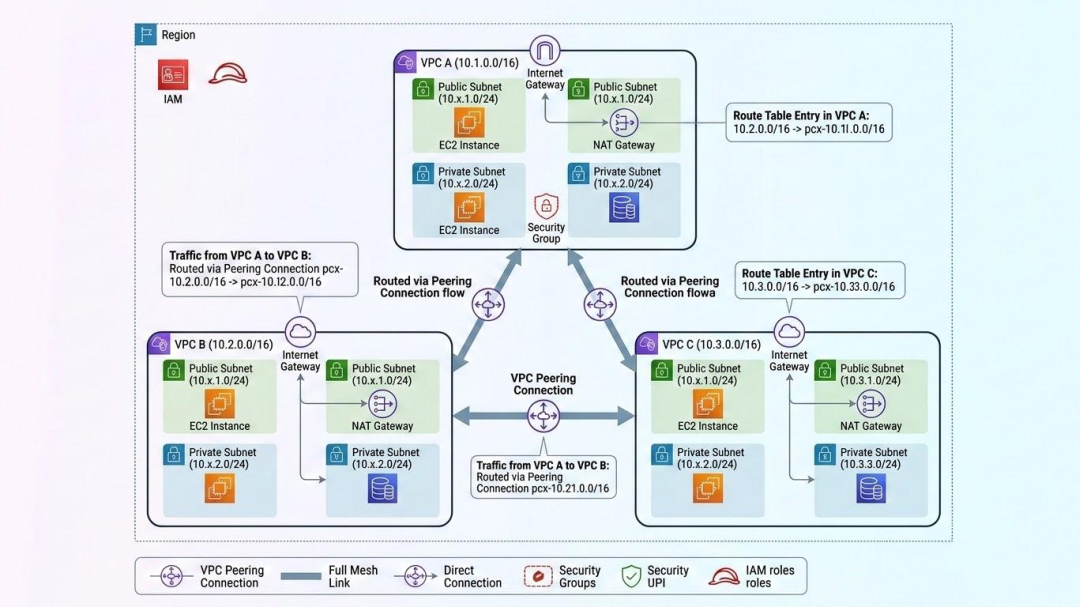
- The "Direct" Advantage: Traffic stays on the AWS private backbone. It never traverses the public internet, ensuring high security and low latency.
- The Cost Factor: This is the biggest selling point. There is no setup fee and no data processing fee for VPC Peering. You only pay the standard inter-AZ data transfer rates.
- The Scalability Trap: VPC Peering is not transitive. If VPC A is peered with VPC B, and VPC B is peered with VPC C, VPC A cannot talk to VPC C. To make that happen, you must create a third peering connection between A and C.
Architect’s Verdict: Peering is the "Formula 1" of connectivity—built for speed and cost-efficiency in specific, point-to-point scenarios.
##
- Transit Gateway: The Regional Command Center AWS Transit Gateway (TGW) is a network transit hub that you can use to interconnect your Virtual Private Clouds (VPCs) and on-premises networks.
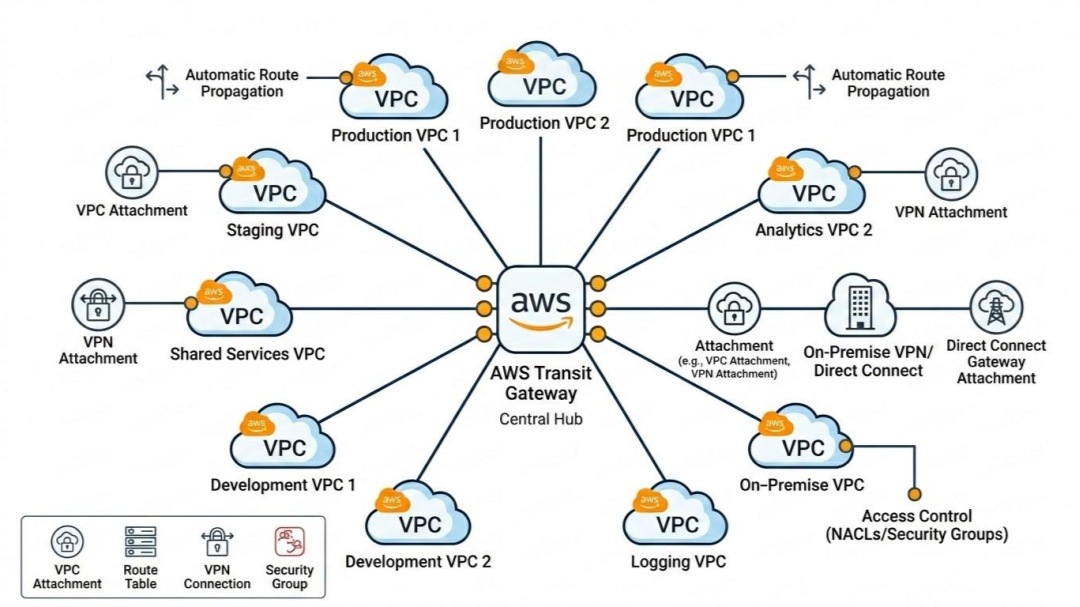
- The Hub-and-Spoke Model: Instead of a "web" of peering connections, every VPC connects once to the TGW.
- Centralized Routing: TGW uses Transit Gateway Route Tables. You can decide which VPCs can talk to each other from a single pane of glass, rather than updating dozens of individual subnet tables.
- Transitive by Nature: Because it acts as a router, if VPC A and VPC C are both attached to the TGW, they can communicate (provided your routing logic allows it).
Architect’s Verdict: TGW is the "Grand Central Station" of your network—built for massive scale, centralized security, and operational sanity.
##
- The Scalability Math: When the "Web" Breaks To understand why architects switch, look at the math of a Full Mesh (where every VPC talks to every other VPC):
- With 10 VPCs, you need 45 peering connections.
- With 100 VPCs, you need 4,950 peering connections.
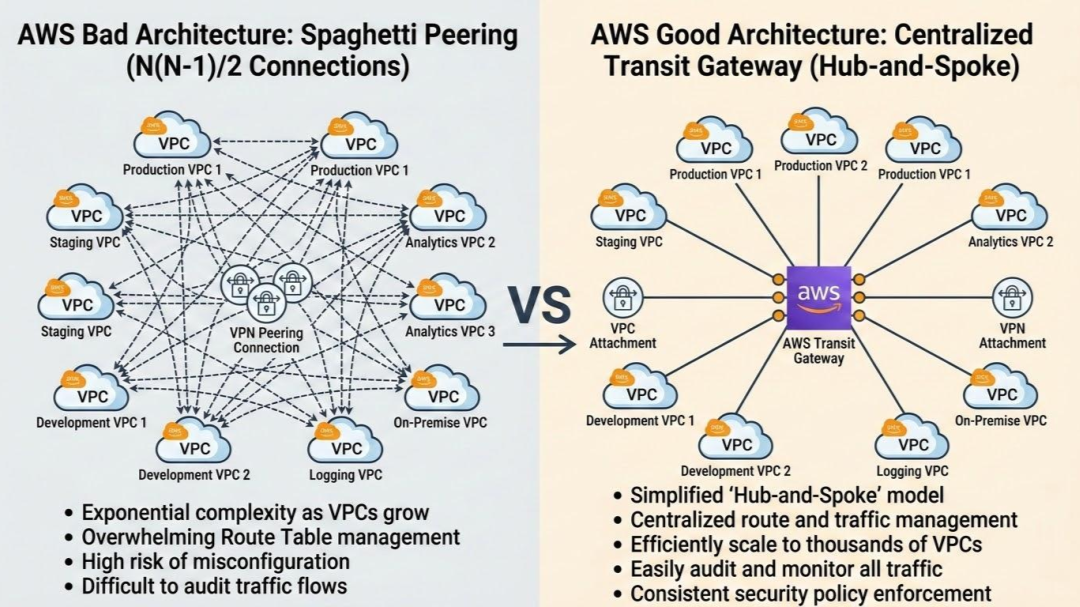
Managing 4,950 connections is an operational impossibility. Transit Gateway reduces this to 100 attachments.
##
- Comparison at a Glance
| Feature | VPC Peering | Transit Gateway |
|---|---|---|
| Routing | Point-to-point (Manual) | Hub-and-Spoke (Centralized) |
| Transitive? | No | Yes |
| Data Processing Fee | $0 (Free) | ~$0.02 per GB |
| Best Use Case | High-volume data transfer between two points. | Large-scale organizations with complex routing. |
SAA-C03 Exam "Pro-Tip":#
If an exam question mentions "operational overhead" or "hundreds of VPCs," look for Transit Gateway. If it emphasizes "lowest cost" for a high-traffic connection between specifically named VPCs, VPC Peering is usually the winner.
🧠 Master the Architecture Every Day#
Understanding the difference between a hub and a peer is only the beginning. Real-world AWS exams test your ability to spot the "tipping point" where a good solution becomes a bad one.
Ready to sharpen your architectural instincts?
Join our Daily Question Streak below.

Indika Kodagoda
Indika Kodagoda is a Lead DevOps Engineer, AWS certification instructor, and the creator of CloudQubes. He specializes in cloud infrastructure, automation, and modern Ruby on Rails development. When he’s not deploying code or mentoring aspiring engineers, he’s usually enjoying nature and cycling local gravel paths.