
Why Microlearning is the Future for DevOps Engineers
Overwhelmed by DevOps training? Learn why daily microlearning is the best way to master AWS, pass cloud certifications, and upskill without the burnout.
format_list_bulleted
Table of Contents
7 sections
expand_more
What do you think if you get to build an airplane while actively flying it.
Impossible!
But, that's not very different from what we are doing as DevOps engineers.
On any given day, our attention is fractured across a dozen different fronts. We are simultaneously debugging pipeline failures, writing clean Infrastructure as Code, and making sure production stays green.
On top of managing that daily operational friction, the ecosystem around us never stops moving. Cloud providers push out hundreds of updates a year, container paradigms shift, and the "industry standard" best practices seem to evolve before the official documentation is even published.
Amidst all of this, the pressure to constantly upskill, master new automation tools, and earn your next cloud certification is immense. Yet, when you actually try to sit down and study, you quickly realize that traditional educational models are fundamentally broken for the realities of this profession.
The Death of the Week-Long Training Bootcamp#
Let's be honest about traditional corporate training.
The idea of stepping away from your desk for a five-day intensive bootcamp is a relic of the past. In modern DevOps, pausing pager duty, handing off active sprint deliverables, or ignoring alerts for an entire week is a luxury that neither you nor your team can realistically afford.
Because of this severe lack of uninterrupted time, the engineering industry is currently suffering from an "abandoned course" epidemic.
You likely know the cycle: you purchase a highly rated, 40-hour comprehensive video course on Kubernetes administration or AWS architecture. You start strong on a quiet Saturday morning. But by Tuesday, a production fire breaks out, sprint priorities violently shift, and that course tab gets buried in your browser before eventually being closed and forgotten entirely.
Furthermore, even if you do manage to secure a week of dedicated training time, monolithic learning is incredibly inefficient for cloud computing. The technology simply moves too fast. By the time you emerge from a massive, week-long deep dive, the specific UI of a cloud console has already changed, or a specific Terraform provider has deprecated the exact resource you just spent hours studying.
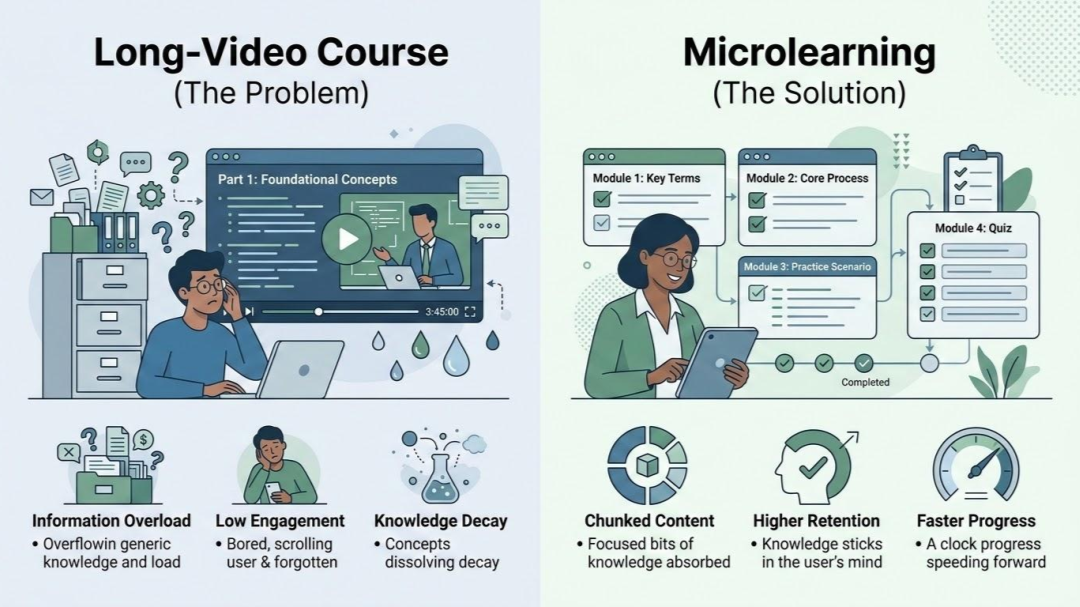
The Core Reality: Training must adapt to the engineer's schedule, not the other way around. The era of monolithic learning is over because contiguous blocks of free time no longer exist in modern operations.
Continuous Integration of Knowledge#
If there is a core tenet of modern software delivery, it is that massive, infrequent deployments are dangerous. We no longer write thousands of lines of code over six months and pray it works on release day. Instead, we rely on Continuous Integration and Continuous Deployment (CI/CD) to merge small, frequent, and manageable batches of code into production.
Why should our approach to learning be any different?
Microlearning is essentially CI/CD for your brain. In an industry where AWS releases hundreds of updates a year and the open-source ecosystem pivots seemingly overnight, waiting six months to take a comprehensive course guarantees your knowledge will be outdated. You cannot afford to batch your learning.
Instead of treating education as a monolithic deployment, microlearning allows you to continuously integrate new concepts into your daily routine.
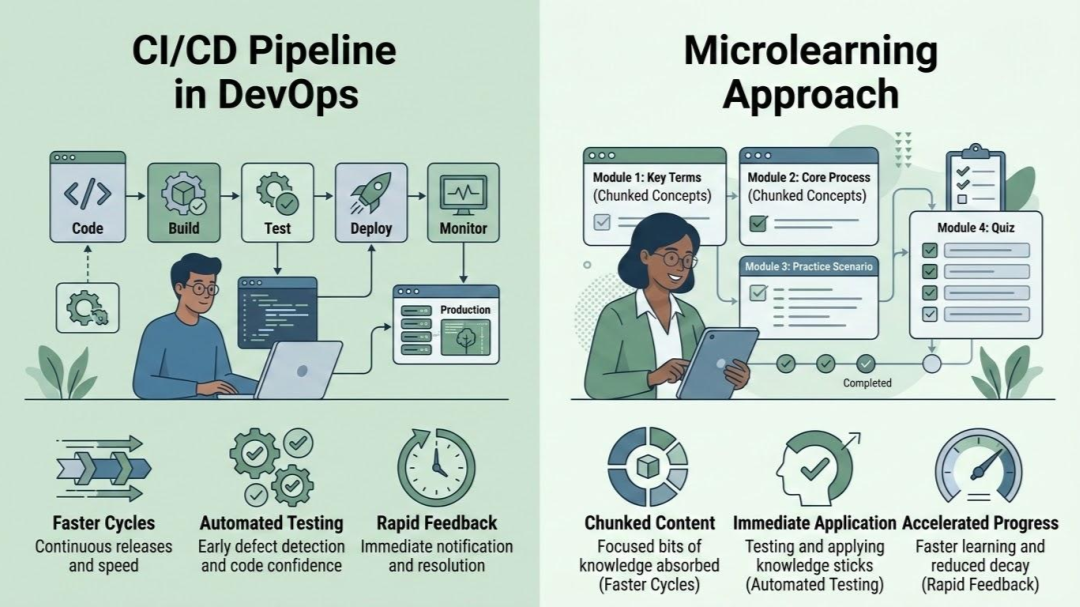
By absorbing a short technical snippet over morning coffee, or completing a single, five-minute hands-on lab before your stand-up meeting, you establish a pipeline of continuous knowledge delivery. You stay at the absolute cutting edge of the industry precisely because you are only processing incremental updates.
Just as small code commits reduce integration risk, daily micro-lessons prevent skill stagnation. You continuously deploy expertise without ever needing to step away for a corporate sabbatical.
High-Retention Certification Preparation#
Earning certifications—whether it is the AWS Cloud Practitioner, Developer Associate, or Certified Kubernetes Administrator (CKA)—is a proven way to validate your skills and advance your career. But preparing for these extensive, grueling exams while maintaining a full-time engineering workload can feel like an impossible task.
When you try to tackle exam prep in massive chunks—cramming VPC peering configurations, IAM role inheritance, and DynamoDB partition keys into a single, exhausted Sunday afternoon—you hit a wall of cognitive overload. Your brain simply cannot process and retain that volume of dense, technical information all at once. You might memorize enough to pass a practice test that day, but a week later, the details will have vanished.
Microlearning solves this through the proven science of spaced repetition. By breaking down massive cloud architectures into daily, isolated modules, you drastically improve your long-term memory retention. Instead of drowning in the entire AWS networking stack, you spend just five minutes on Tuesday truly understanding how a NAT Gateway functions. On Wednesday, you spend five minutes mastering Route 53 routing policies.
Consistent, bite-sized study prevents the "cram and forget" cycle. It transforms fragile, short-term memorization into the deep, intuitive understanding you actually need—not just to pass the exam, but to build resilient infrastructure in the real world.
"Just-in-Time" Problem Solving#
When an infrastructure bug halts a deployment or a production pipeline suddenly turns red, broad theory goes out the window. In the middle of an outage or a sprint crunch, you do not have the luxury of skimming a 40-page textbook chapter on state management or sitting through a 20-minute video introduction. You need a specific solution, and you need it right now.
Traditional training formats fail in these moments, but microlearning thrives here because it caters directly to "just-in-time" problem-solving. Well-structured micro-content skips the introductory fluff and delivers actionable precision. If you are struggling with a specific configuration, a three-minute targeted tutorial on exactly how to implement the aws_ec2_managed_prefix_list data source in Terraform, or a quick snippet detailing the correct directory pathing for ansible_collections, provides immediate, tangible value.
Because microlearning modules are naturally hyper-focused, they function less like a traditional course and more like a highly indexed, searchable reference guide tailored for the trenches of daily operations.
Microlearning bridges the gap between abstract theory and production emergencies. It provides immediate, actionable precision that gets engineers unstuck and pipelines moving again in minutes.
Fitting the Context-Switching Workflow#
A typical day in DevOps is rarely linear; it is inherently fragmented.
Within a single afternoon, you might jump from drafting an Ansible playbook, to debugging a failing Ruby on Rails backend deployment, to adjusting alert thresholds in Prometheus. Your brain is constantly shifting gears to accommodate different tools, environments, and sudden operational demands.
Because of this constant context-switching, scheduling a dedicated hour for uninterrupted study is nearly impossible. However, what every DevOps engineer does have is the inevitable "pipeline wait time." You write a script, push the commit, trigger the CI/CD pipeline, and wait. You execute a terraform apply and watch the terminal output while your cloud resources provision.
Microlearning is perfectly engineered to exploit these natural, three-to-five-minute gaps in your day. Instead of losing focus by mindlessly scrolling through Slack or Reddit while waiting for a build to finish, you can seamlessly consume a short tutorial on Kubernetes pod affinity or complete a quick quiz on AWS security groups.
Microlearning doesn't ask you to find more time in your day; it asks you to reclaim the idle time you already have. It turns mandatory waiting periods into compounding professional growth without disrupting your workflow.
Reducing the Barrier to Mentorship#
One of the hidden bottlenecks in any growing engineering organization is onboarding and mentorship.
Senior engineers and team leads genuinely want to upskill their junior colleagues, but they are often drowning in their own operational responsibilities. Blocking out three hours for a whiteboard session to explain Kubernetes networking or setting up custom Terraform modules is a massive drain on a senior engineer's bandwidth.
Microlearning offers a highly scalable, asynchronous solution to this dilemma. Instead of repeating the same foundational lectures to every new hire, senior engineers can curate a playlist of existing micro-lessons, short daily digests, or quick reference snippets.
When a junior engineer gets stuck on IAM role policies or container orchestration concepts, pointing them to a focused, five-minute module allows them to self-serve the answer. This empowers junior staff to build their professional value and practical skills independently, without feeling like they are constantly interrupting their senior counterparts.
Curating microlearning content allows senior engineers to mentor at scale. It removes the bottleneck of synchronous, time-heavy training sessions, empowering teams to upskill asynchronously while keeping senior engineers focused on high-level architecture.
Wrapping up: Mastering the Cloud, Five Minutes at a Time#
The sheer volume of knowledge required to be a successful DevOps engineer can feel overwhelming, but the path to mastery does not require you to put your life or your work on hold. You do not need to miraculously find five extra hours in your already exhausted week to become a top-tier engineer. You simply need five minutes a day, applied consistently.
By shifting away from monolithic bootcamps and embracing microlearning, you stop fighting against the realities of your profession and start leveraging them. You turn idle wait times into compounding knowledge, defeat the cognitive overload of certification prep, and build a continuous pipeline of actionable expertise.
This is the exact philosophy behind CloudQubes. We believe that learning should adapt to the engineer, not the other way around. That is why we deliver a single, highly focused cloud certification exam question directly to your inbox every day. By challenging yourself with just one practical scenario at a time—whether it is a tricky VPC routing problem or an IAM permission hierarchy—we help you break down the mountain of cloud computing into a series of manageable, actionable steps.
Stop abandoning 40-hour courses and start building your expertise one question at a time. Subscribe to CloudQubes today, and turn your next pipeline wait time into your next certification breakthrough.

Indika Kodagoda
Indika Kodagoda is a Lead DevOps Engineer, AWS certification instructor, and the creator of CloudQubes. He specializes in cloud infrastructure, automation, and modern Ruby on Rails development. When he’s not deploying code or mentoring aspiring engineers, he’s usually enjoying nature and cycling local gravel paths.