
The Death of Cramming: Why Microlearning is the Ultimate Strategy for Certification Prep
Stop cramming for IT certifications. Discover how busy engineers use microlearning, daily streaks, and active recall to master cloud certification exams.
format_list_bulleted
Table of Contents
5 sections
expand_more
You know the drill.
You decide to level up, book your exam date, and suddenly you are staring down a 600-page official study guide and a 40-hour video course.
You sacrifice your weekends, consume alarming amounts of caffeine, and attempt to force-feed your brain an impossible volume of architectural diagrams, network protocols, and API limits.
This is the traditional model of technical certification prep. But, it is fundamentally broken.
The primary issue isn't just the inevitable burnout—it is the illusion of competence. Binge-studying and marathon video sessions allow you to hold just enough information in your short-term memory to scrape a passing score.
But, say, three weeks later a production deployment fails. Or you need to configure a complex multi-region failover. That crammed knowledge has already evaporated. The "data dump" approach optimizes purely for the test, leaving you unprepared for the actual job.
There is a better way to master dense infrastructure blueprints, one that works with the biological limits of human memory rather than against them.
Microlearning—the practice of consuming targeted, bite-sized concepts through consistent daily habits—replaces the exhausting weekend cram session with frictionless, high-retention learning. By shifting the focus from massive volume to daily, strategic repetition, microlearning stands as the most efficient strategy not just to conquer the exam, but to permanently wire those critical skills into your engineering toolkit.
Beating Cognitive Overload in Complex Architectures#
To understand why traditional study methods fail, you have to look at the brain as a system with hard computational limits.
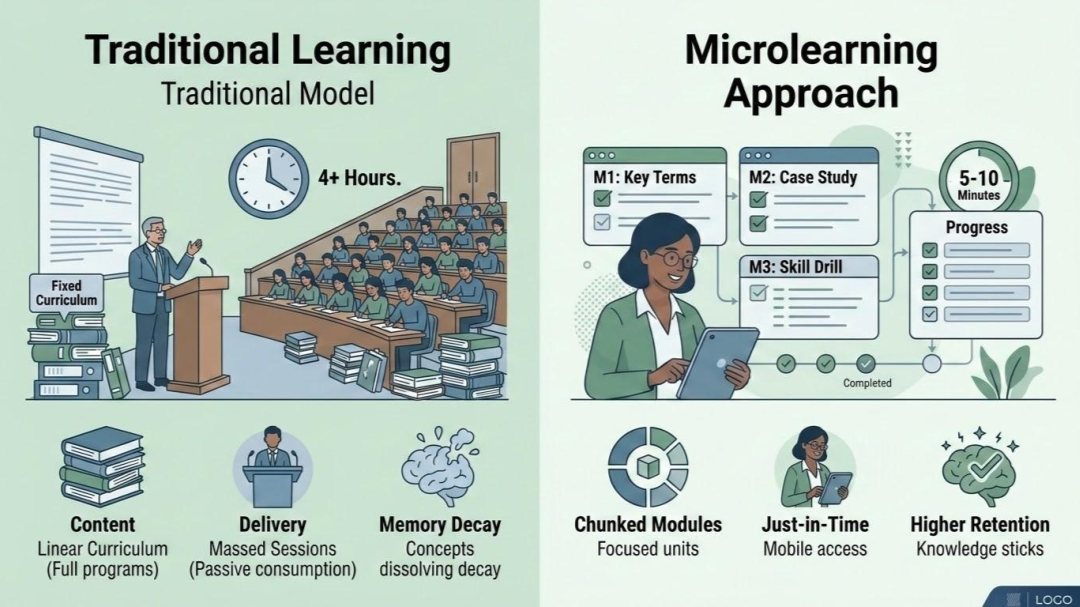
According to Cognitive Load Theory, human working memory acts as a strict bottleneck—it can only hold and process roughly four to seven new pieces of information at any given time. Everything else is dropped.
When you attempt to learn complex cloud infrastructure through a massive "data dump," you immediately overwhelm this buffer. Imagine sitting down for a two-hour video lecture that simultaneously covers VPC peering, Transit Gateway attachments, routing table logic, and stateful versus stateless security group evaluation. The volume of distinct concepts far exceeds your working memory’s capacity. Just like a server hit with a massive spike in unoptimized traffic, your brain starts dropping packets. The resulting mental fatigue means you are spending energy simply trying to organize the noise, rather than actually storing the knowledge.
Microlearning acts as a cognitive rate limiter. It strips away the extraneous noise and isolates a single, hyper-focused learning objective.
Instead of an hour-long module on "AWS Security," a micro-lesson focuses entirely on one specific mechanism—for example, exactly how IAM permission boundaries evaluate access against identity-based policies. By feeding the brain a single, coherent concept, you keep the cognitive load well below the threshold. This frees up your mental energy to fully process the mechanism, connect it to your existing architectural knowledge, and successfully write it to long-term memory.
The Forgetting Curve and the Power of the Daily Streak#
Even if you successfully bypass cognitive overload and perfectly encode a new piece of infrastructure logic, you still face a biological hurdle: memory decay.
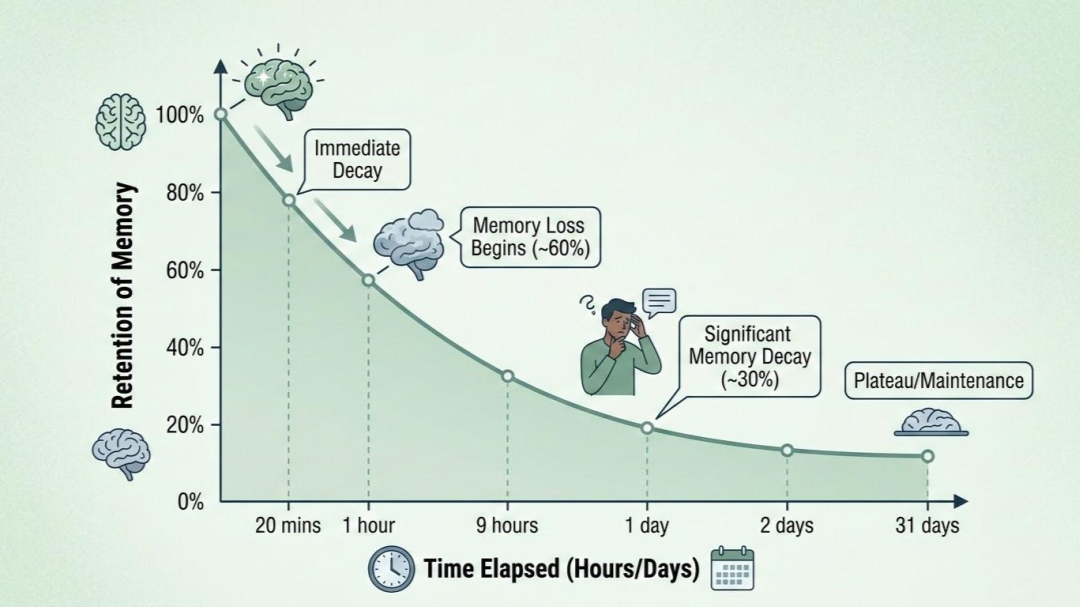
In the late 19th century, psychologist Hermann Ebbinghaus demonstrated this through the "forgetting curve." His research revealed a brutal reality for anyone studying for a complex exam: without active reinforcement, the human brain discards roughly 50% of new information within an hour, and up to 90% within a week. If you cram a dense topic on a Sunday, by Thursday, that knowledge is essentially gone. Binge-studying is the biological equivalent of writing data to volatile RAM—the moment you step away, the state is lost.
To permanently write this data to disk, you have to leverage the Spacing Effect.
The Spacing Effect is the cognitive phenomenon where learning is significantly more effective when study sessions are spaced out over time rather than massed together. When you allow a memory to slightly fade and then force yourself to recall it, the brain has to work harder to retrieve the information. This friction is exactly what you want. That struggle to remember thickens the neural pathways, signaling to your brain that this information is important enough to keep long-term.
This is where passive reading fails and active microlearning excels—specifically through a daily question streak.
Instead of staring at a textbook, the most effective implementation of the Spacing Effect is receiving a single, scenario-based exam question in your inbox every morning. This creates a frictionless mechanism for active recall. A daily email forces you to pause, retrieve technical context, and apply it to a specific problem. By solving one bite-sized challenge every day, you systematically interrupt the forgetting curve. It transforms a massive, intimidating syllabus into a lightweight, recurring cron job for your brain, locking in the knowledge precisely when it is on the verge of fading.
Zero-Friction Consistency for Busy Engineers#
Operations and infrastructure management are inherently interrupt-driven. Between investigating monitoring alerts, unblocking developers, and managing cloud state, finding three uninterrupted hours for study is practically impossible. The traditional learning model demands massive, dedicated blocks of time that simply do not exist in a modern engineering day.
Microlearning flips this dynamic by taking advantage of the inevitable "dead time" scattered throughout your shift.
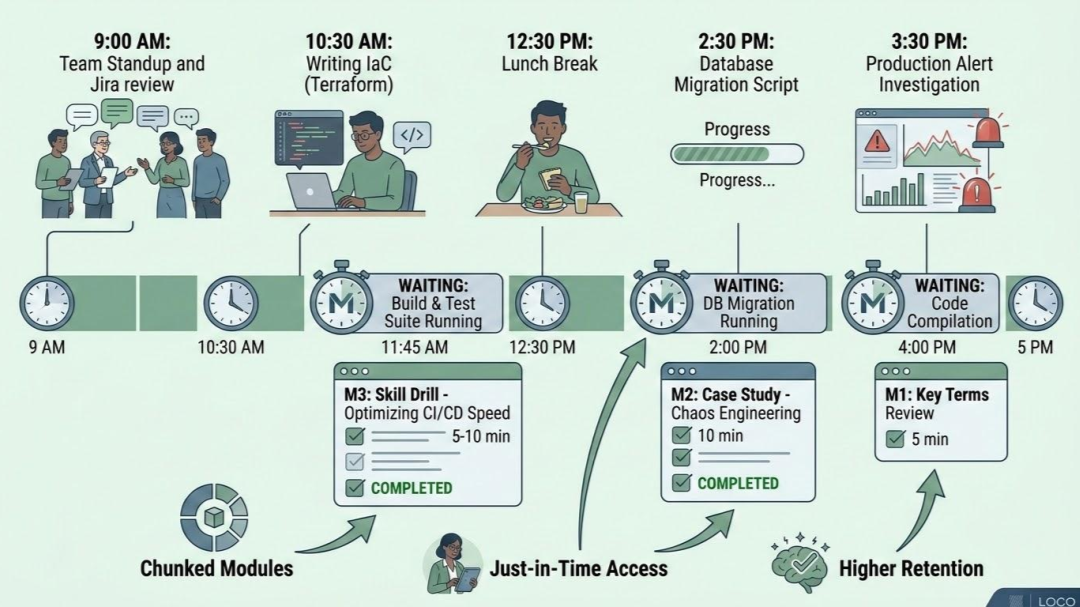
A five-minute technical breakdown doesn't require blocking off your calendar or putting your chat status on "Do Not Disturb." It fits perfectly into the natural pauses of your workflow. You can easily consume a micro-lesson while waiting for a GitHub Actions workflow to turn green, while a rootless Podman container finishes building, or during a commute.
Beyond scheduling, this creates powerful psychological momentum. Staring down a 40-hour video series triggers deep procrastination because your brain recognizes the massive energy expenditure required. By contrast, a single, five-minute daily task completely bypasses that friction. It feels manageable, and checking that daily box builds a compounding habit of continuous professional development that feels effortless rather than exhausting.
Blueprint in Action: Tackling a Heavyweight Exam#
To see how this works in practice, let's apply the microlearning framework to a notoriously broad and demanding certification: the AWS CloudOps Engineer (SOA-C03) exam.
The syllabus for SOA-C03 is exceptionally dense, requiring a deep understanding of deployment, management, and operational mechanics across the AWS ecosystem. If you look at a massive domain like "High Availability and Business Continuity," trying to memorize all the moving parts in one weekend is a recipe for cognitive overload.
Instead, we deconstruct that massive domain into a sequence of daily, bite-sized lessons. Here is how that looks in a microlearning streak:
- Day 1: Focus entirely on Route 53 health check configurations and how they trigger specific routing policies.
- Day 2: Move strictly to Auto Scaling group lifecycle hooks and how they manage state transitions during scale-out events.
- Day 3: Break down the exact backend failover mechanics and DNS propagation of a Multi-AZ RDS deployment.
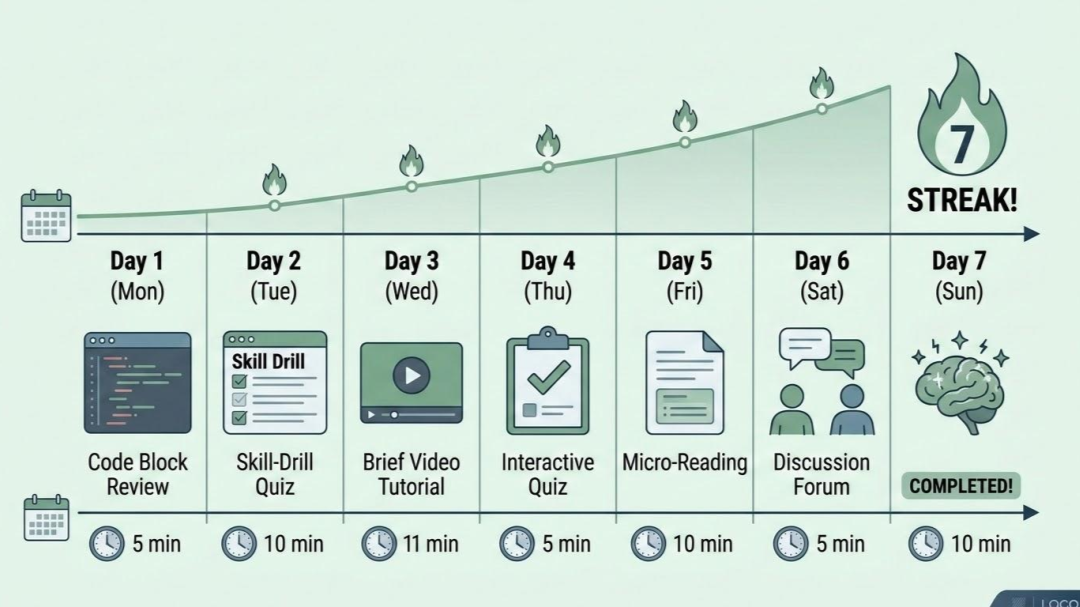
By isolating these concepts, you aren't just skimming the surface of a study guide; you are fundamentally understanding the underlying architecture of each mechanism before stacking the next one on top. When you compound this daily, five-minute habit over a 90-day period, the result is profound. You arrive at exam day with deep, structural mastery of the platform, rather than relying on the fragile, crammed memorization that disappears the moment you walk out of the testing center.
Conclusion: Shifting the Goal from Passing to Mastering#
At its core, microlearning is simply an acknowledgment of reality. It respects the relentless schedule of a working engineer and aligns exactly with the strict biological limits of human working memory.
Certifications should never be an exercise in temporary memorization just to add a badge to your professional profile. The true value of a rigorous exam blueprint is building a mental model you can actually rely on during a Sev-1 outage or a complex multi-region failover. When you cram, you are optimizing only for a passing score. By adopting a spaced, incremental approach, you ensure that the architectural concepts you learn become permanent fixtures in your engineering toolkit, ready to be deployed the moment a real-world problem arises.
It is time to abandon the exhausting, low-yield weekend cram sessions. Instead, build a learning system that actually works with your brain's architecture. Subscribe to a daily question streak, commit just five minutes a morning to active recall, and let the compounding power of consistent microlearning turn exam preparation into genuine technical mastery.

Indika Kodagoda
Indika Kodagoda is a Lead DevOps Engineer, AWS certification instructor, and the creator of CloudQubes. He specializes in cloud infrastructure, automation, and modern Ruby on Rails development. When he’s not deploying code or mentoring aspiring engineers, he’s usually enjoying nature and cycling local gravel paths.