
The 2026 IaC Learning Blueprint: From Syntax to Systems Thinking
How to start learning IaC with AI in 2026 (for absolute beginners)
format_list_bulleted
Table of Contents
22 sections
expand_more
If you are starting your cloud engineering journey today, you are entering a completely different landscape than the engineers who came just a few years before you.
The barrier to writing Infrastructure as Code (IaC) has plummeted. Need a Terraform module for an Application Load Balancer? Want to write an Ansible playbook to configure a fleet of Linux servers? A generative AI tool can output the required boilerplate in seconds.
The AI Paradigm Shift in Infrastructure#
But this convenience hides a dangerous trap for beginners: confusing code generation with systems engineering.
The reality is that AI has commoditized the syntax, but it has not commoditized the architecture. In modern DevOps, the most critical skill is no longer memorizing how to write HCL or YAML from a blank screen. The modern role is that of an architectural editor.
Your value lies in understanding the core concepts underlying the code. An AI can type out a routing table or a NAT gateway configuration flawlessly, but it doesn't inherently understand the operational constraints, the security posture, or the cost implications of what it just built. It will not know if a generated IAM policy is overly permissive, or if a multi-region deployment is overkill for your budget.
This means your learning path must shift. Instead of spending weeks fighting syntax errors, your focus must move to what happens before and after the code is written. You must learn to read and debug structural logic, understand how different cloud components interact, and master the mechanics of state management and safe execution.
AI is an incredibly powerful multiplier, but it is effectively blind to your specific operational reality. It cannot replace foundational systems thinking—it only amplifies the engineer who already understands what good architecture looks like. To succeed today, you must focus strictly on the foundational concepts. This guide will show you exactly where to direct your focus so you can wield these modern tools safely and effectively.
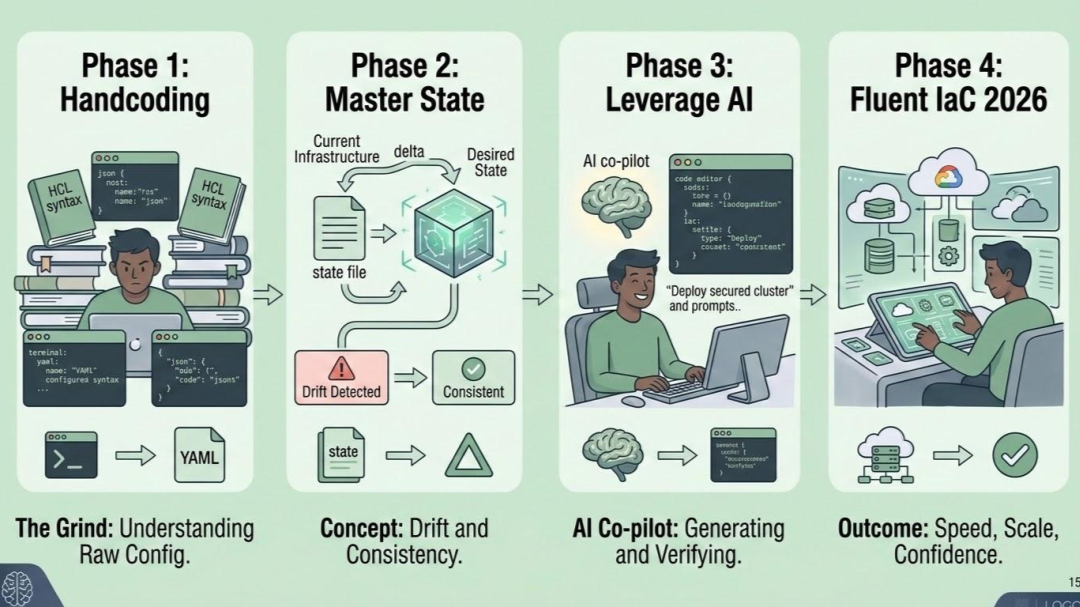
The Unshakable Foundations (Hand-Coding Phase)#
Before you can automate infrastructure, you have to understand the infrastructure you are automating.
Infrastructure as Code is not a magic layer that abstracts away the underlying reality of systems engineering; it is simply a delivery mechanism. If you do not understand how a system works when you build it manually, generating the code for it will only help you deploy a broken architecture faster.
Networking and Systems First#
At its core, cloud engineering is just distributed Linux and networking.
If you rely on an AI to write your IaC without understanding these concepts, you will inevitably hit a wall when things break. You must understand the difference between a public and private subnet, how route tables direct traffic, and why a NAT Gateway is required for outbound internet access from private instances. When a deployment fails because a security group is blocking port 443, an automated assistant cannot intuitively diagnose the dropped packets. You have to know the foundational networking concepts to know exactly where to look in your architecture.
Building the Muscle Memory#
For your first few architectural deployments, turn the AI generation tools off entirely.
Open your code editor and write the configurations by hand. This forced friction is where the actual learning happens. Typing out the code forces you to internalize the syntax structure, understand the required parameters for each resource, and recognize the structural patterns that the IaC language uses to construct environments.
The Dependency Graph#
When you hand-code, you learn how declarative tools actually think. Terraform, for example, does not just read a file top-to-bottom; it builds a mathematical dependency graph.
You learn that to create a virtual machine, you first need a subnet ID, and to get that subnet ID, you first need to create a Virtual Private Cloud (VPC). Manually passing these identifiers between resource blocks teaches you the critical execution order of cloud provisioning.
Reading Provider Documentation#
Hand-coding forces you to constantly reference the official documentation, which builds the most important reflex a modern DevOps engineer can have: mapping provider registries to actual cloud APIs. You will quickly learn that "close enough" is not good enough.
For example, if you need to manage network routing lists in AWS, an LLM might confidently generate a generic block for an aws_prefix_list — but by reading the documentation, you learn that managing your own custom list requires the exact aws_ec2_managed_prefix_list data block wrapper. If you haven't built the habit of verifying exact syntax against the official provider registries, these subtle API mismatches will cost you hours of debugging.
Execution, State, and the Blast Radius#
Writing the code is only 10% of the job. The real danger—and the true power—of Infrastructure as Code lies in its execution. When you write application code, a bug might crash a microservice. When you execute an IaC deployment, a logic error can destroy your entire production database or sever routing to your primary network. This is the "blast radius."
To manage this risk, you must master how IaC engines translate your static code into real-world changes.
The Concept of State#
Declarative tools like Terraform do not simply run a series of commands from top to bottom. They operate as a state machine. When you deploy infrastructure, the tool creates a "state file"—a complex JSON map that tracks the exact relationship between your written configuration and the physical resources running in the cloud.
Understanding state is non-negotiable. When you command the engine to deploy, it compares your code to this state file, calculates the difference, and generates an execution plan. If you do not deeply understand how this comparison works, you cannot accurately predict what the engine is about to create, modify, or destroy.
Handling Configuration Drift#
Infrastructure rarely remains static. Eventually, a critical incident will occur, and an engineer will log directly into the cloud console to manually change a configuration—perhaps opening a security group port or scaling up a database instance to handle a traffic spike. This creates "drift," where the reality of your cloud environment no longer matches your code.
When you next run your IaC pipeline, the engine will detect this drift and attempt to revert the manual change to match the codebase. A modern engineer must know how to intercept this execution plan, evaluate the drift, and reconcile the codebase with reality before a destructive deployment occurs.
State Manipulation (Where AI Fails)#
This is the phase where heavy reliance on AI will actively harm you. AI tools are excellent at generating static files from scratch, but they are notoriously terrible at manipulating existing state.
If you are restructuring your project—say, moving a resource block from one module to another, or adopting manually created cloud resources into your IaC management—you must perform precise CLI operations. You need to confidently wield commands like terraform state mv (to rename resources without destroying them) or terraform import (to map existing infrastructure to your code). These are delicate, surgical operations on the state file that require human architectural context. If you trust an AI to refactor code without manipulating the state file to match, the engine will simply destroy your live infrastructure and recreate it from scratch.
The GitOps Concept and the Blast Radius#
Because the blast radius of an IaC deployment is so massive, executing code from your local laptop command line is an anti-pattern. This is where GitOps comes in.
In a modern workflow, your Git repository is the absolute single source of truth. You do not manually run deployment commands. Instead, you commit your code and open a pull request. This triggers a continuous integration (CI) pipeline that generates the execution plan, runs automated security checks against it, and posts the results for your team to review. Only after a human engineer approves the architectural logic does the pipeline apply the changes to the live environment. Mastering this pipeline is what separates a beginner who writes code from a DevOps engineer who safely manages systems at scale.
Leveraging AI as an Infrastructure Multiplier#
Once you have a firm grasp on networking fundamentals and state mechanics, you can safely bring AI tools back into your daily workflow. At this stage, AI stops being a crutch that masks your knowledge gaps and becomes a powerful engine that accelerates your output.
Accelerating Translation and Refactoring#
One of the highest-value uses of Large Language Models (LLMs) in DevOps is translation.
In the real world, you will rarely start with a blank slate. You will often inherit massive, imperative Bash scripts, Python automation, or legacy configuration files that a previous engineer wrote to provision environments manually.
AI excels at reading these procedural scripts and refactoring them into declarative, idempotent Infrastructure as Code. You can feed a 500-line shell script into an LLM and have it accurately map those imperative commands into a clean Ansible playbook or specialized container orchestration files. The AI does the tedious syntax translation, leaving you to review the structural logic.
AI-Assisted Debugging#
When an IaC deployment pipeline fails, the root cause is rarely a simple typo. It is often a complex dependency issue or a provider API conflict buried deep within a massive execution log.
Instead of manually parsing thousands of lines of output, you can leverage AI as a diagnostic assistant. By feeding execution logs or Terraform provider errors into an LLM, you can quickly pinpoint data type mismatches, misconfigured loop structures, or specific resource conflicts. However, because you completed the hand-coding phase, you won't blindly copy and paste the AI's suggested fix; you will use its analysis to verify the exact issue in your architecture and correct it safely.
Context and Prompting Constraints#
AI is a context-dependent engine. If you prompt an AI with a vague request like "build an AWS network," it will generate a generic, cookie-cutter baseline that likely violates your organization's security and cost policies.
To use AI effectively, you must provide strict architectural boundaries. A modern engineer doesn't prompt for code; they prompt with constraints. You must learn to feed the AI your specific requirements: "Generate a Terraform module for an Application Load Balancer. It must only allow internal VPC traffic, enforce TLS 1.2, require an existing AWS WAF association, and apply our standard billing tags."
The AI is acting as your junior developer. The quality and safety of the infrastructure it generates will always be directly proportional to the exact architectural context and constraints you provide in your prompt.
Advanced Guardrails and Policy as Code#
When AI is generating infrastructure, the speed of development increases exponentially. But so does the speed at which you can deploy catastrophic security vulnerabilities or massive billing errors. Human code review is no longer sufficient to catch every hallucinated wildcard permission or unencrypted storage volume. To operate safely at scale, you must build automated systems that police the AI for you.
Shifting Security Left#
In traditional IT, security was often a final check right before—or even after—systems went live. In a modern DevOps workflow, security must "shift left," meaning it happens at the very beginning of the pipeline.
Before a single resource is provisioned, your CI/CD pipeline should automatically scan the generated HCL or YAML using static analysis tools like Checkov or tfsec. These tools parse the code to catch wide-open security groups (0.0.0.0/0), missing encryption keys, or overly permissive IAM roles. If the AI hallucinates a configuration that violates basic security principles, the pipeline should instantly fail and block the deployment.
Policy Enforcement via Policy as Code (PaC)#
Static security scanning is the baseline, but you also need to enforce your organization's specific business and operational rules. This is achieved through Policy as Code (PaC) using engines like Open Policy Agent (OPA) or HashiCorp Sentinel.
PaC allows you to write strict, executable rules that govern what can and cannot be deployed. For example, you can write a policy that automatically rejects any pull request attempting to provision a database instance larger than a specific size, or a rule that requires every deployed resource to have an exact billing_center tag. If an engineer uses an LLM to generate an architecture that forgets these tags, the PaC engine acts as an automated, impassable gatekeeper.
Compliance-Aligned Generation#
As you mature in your IaC journey, you can begin to integrate these policies directly into your generative workflows. Instead of just blocking bad code after it is written, modern teams tie their Policy as Code and cloud Service Control Policies (SCPs) directly into their AI tooling's context.
By feeding your OPA rules into the AI's system prompt, you ensure that the AI is aware of your internal guardrails before it even begins generating. This creates a closed-loop system where the AI is constrained by the exact same compliance rules that the CI/CD pipeline enforces, drastically reducing the friction between rapid generation and secure deployment.
Your Next Steps#
The Endgame: The Internal Developer Platform (IDP)#
As you master these foundational concepts, execution safety, and AI guardrails, you will realize that writing infrastructure is only a means to an end. The ultimate goal of a modern DevOps engineer is not to manually deploy infrastructure upon request, but to build an Internal Developer Platform (IDP).
An IDP abstracts the complexity of the cloud away from application developers. By combining your foundational systems knowledge, robust continuous integration tooling, and automated Policy as Code guardrails, you create a secure, self-service engine.
Application developers can simply request a new environment, and your platform automatically generates, validates, and deploys the underlying infrastructure safely without manual intervention. At this stage, you evolve from an infrastructure operator into a platform creator.
Your Call to Action#
Reading about state management and blast radiuses won't build the necessary muscle memory. You need to get your hands dirty, and the best way to do that is to adopt a micro-learning structure. Build a daily streak of interacting with your infrastructure code so the concepts become second nature.
Start with this exercise:
- Turn off the AI assistants. Open your editor and hand-code a basic two-tier architecture from scratch.
- Build the foundation. Provision a Virtual Private Cloud (VPC), configure the public and private subnets, set up the routing tables, and deploy a web server alongside a database.
- Intentionally break it. Once the architecture is running, log into your cloud console and manually delete a critical security group rule or detach an internet gateway.
- Practice the recovery. Run your IaC execution plan and study exactly how the state machine recognizes the configuration drift and attempts to reconcile reality with your code.
AI is an incredibly capable co-pilot, but during a production outage, the only intelligence you can truly rely on is your own foundational understanding of the system. Close the chatbot, open your terminal, and start building.

Indika Kodagoda
Indika Kodagoda is a Lead DevOps Engineer, AWS certification instructor, and the creator of CloudQubes. He specializes in cloud infrastructure, automation, and modern Ruby on Rails development. When he’s not deploying code or mentoring aspiring engineers, he’s usually enjoying nature and cycling local gravel paths.