
Tech Specialization: The Strategy in 2026 to stay relevant and employable
The IT industry isn't a gold mine for generalists anymore. Discover the 5 high-growth software engineering specializations dominating 2026 and how to pivot your career.
format_list_bulleted
Table of Contents
8 sections
expand_more
The tech job market is in a turmoil.
If you’ve spent any time on tech forums or LinkedIn lately, you’ve probably seen the posts: “IT is no longer a gold mine,” or “Entry-level jobs are impossible to find.”And honestly? They’re kind of right—at least, if you’re playing by the old rules.
A few years ago, you could graduate with a standard IT or Computer Science degree, build a basic React To-Do app, label yourself a "Full Stack Developer," and comfortably land a high-paying job.
Today, that reality is gone. The entry-level market is incredibly saturated, and if you apply as a generalist, you are competing with thousands of other graduates who have the exact same resume and the exact same portfolio.
Welcome to the Generalist Trap.
But here is the good news: the tech industry isn't dying, shrinking, or closing its doors. It is simply maturing.The jobs are absolutely still there, and companies are actually desperate for talent.
The catch?
They don't want generalists anymore. They want specialists.
The hiring criteria has shifted from "knowing a little bit about everything" to "knowing a lot about specific, high-demand infrastructure."If you want to build a financially rewarding, future-proof career today, you have to look at where enterprise budgets are actually flowing.
The era of the generic coder is fading, making way for the era of the Cloud Architect, the Data Engineer, the AI/ML Specialist, and the DevSecOps professional.
Don't just take my word for it. Check out the data below to see how these specialized fields are dominating the market in demand and growth compared to standard development roles.
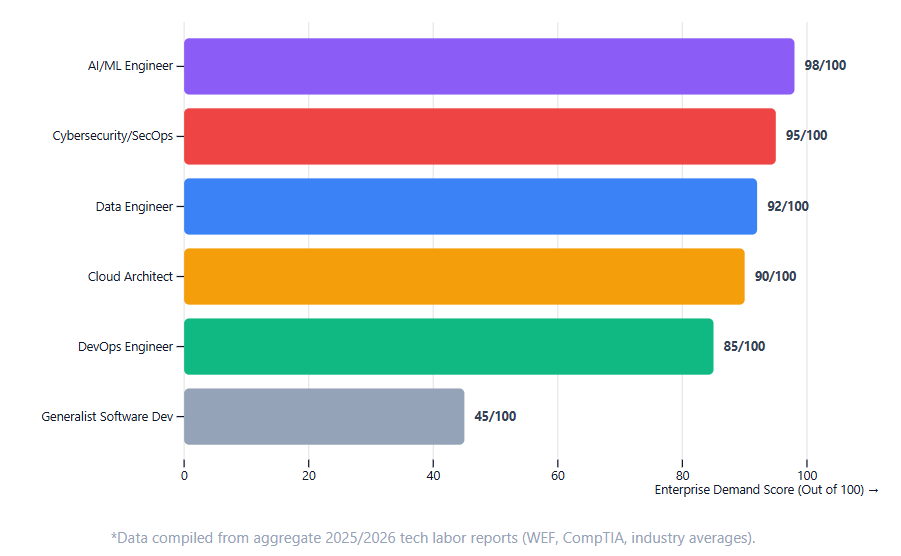
Note: The "Enterprise Demand Score" isn't a random number. It's a composite metric used by major labor analytics firms. They calculate it by combining the raw volume of job postings, the year-over-year growth rate of the skill, the lack of available talent (supply vs. demand), and the earning potential of the role.
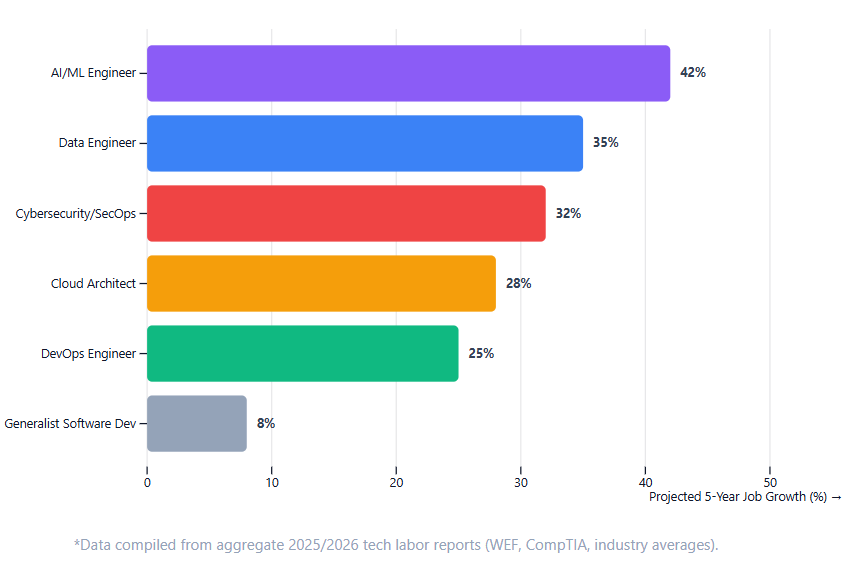
The 2026 Specialization Blueprint#
As you can see companies are scaling back on generic coding roles, and expanding on specialized roles.
Here are the five specialized disciplines driving the tech economy in 2026—and why each one represents a massive opportunity if you're willing to go deeper than a standard computer science curriculum.
#1. Cloud Architecture & Engineering (The Bedrock)#
Think of cloud computing as the utility grid of modern software. Almost every app, enterprise database, and AI model lives in AWS, Microsoft Azure, or Google Cloud.
As companies move away from simple "lift-and-shift" migrations toward complex multi-cloud ecosystems, they desperately need engineers who can design scalable, resilient, and cost-effective cloud architectures.
*Why it’s booming: * Cloud isn't just a discipline; it’s the underlying infrastructure for everything else on this list.
Core focus: Infrastructure as Code (Terraform), cloud networking, security, and multi-cloud strategy.
#2. Data Engineering#
Here’s an open secret in tech: AI models and flashy analytics dashboards are completely useless if the underlying data is broken, missing, or messily organized.
Data Engineers are the unsung heroes who build the high-speed pipelines that collect, clean, and transport massive volumes of raw data into warehouse systems like Snowflake and Databricks.
Why it’s booming: Companies are drowning in data, but starved for clean, structured information. Data Engineering has become one of the highest-paid technical tracks in software.
Core focus: Advanced SQL, Python, real-time streaming (Kafka), ETL/ELT pipelines, and data warehousing.
#3. AI/ML & MLOps Engineering#
We’ve officially moved past the phase where AI is just a fun gimmick or a chatbot experiment. Enterprise companies are now embedding AI directly into their core production software.
However, writing a quick prompt using an API isn't enough to make you an AI engineer. Companies need specialists who understand how to fine-tune models, optimize LLM infrastructure, manage Model Context Protocol (MCP) servers, and reliably deploy models into production without burning through cloud budgets.
Why it’s booming: Building an AI prototype is easy; running a secure, enterprise-scale AI system in production is extremely hard.
Core focus: Python, PyTorch, MLOps pipelines, vector databases, and LLM orchestration.
#4. DevOps & Platform Engineering#
Developers want to write feature code; companies want to ship that code to users fast without breaking the system. That’s where DevOps and Platform Engineers come in.
Instead of managing servers manually, Platform Engineers build internal developer platforms and automated pipelines so engineering teams can deploy software smoothly with a single click.
Why it’s booming: Speed and reliability win market share. Companies pay top dollar for engineers who can automate deployment pipelines and manage cloud infrastructure at scale.
Core focus: CI/CD pipelines, Docker, Kubernetes, Ansible, and Site Reliability Engineering (SRE) observability.
#5. Cybersecurity & DevSecOps#
With data breaches making headlines weekly and cloud networks becoming more complex, security is no longer an afterthought tucked away in a separate department. It's being built directly into every line of code.
DevSecOps engineers bridge the gap between software development, cloud infrastructure, and security compliance, ensuring that applications are hardened against attacks from day one.
Why it’s booming: Cybersecurity has virtually zero unemployment. As threat vectors grow more sophisticated, companies can't afford not to hire security specialists.
Core focus: Zero Trust architecture, identity & access management (IAM), cloud security compliance, and automated security scanning.
How to Specialize Without Burning Out#
Okay, take a deep breath. Looking at that list above can feel incredibly overwhelming. You might be thinking, "I just spent three years learning how to center a div and write basic Java, and now you want me to learn Kubernetes and vector databases?!
"Don't panic. You don't need to learn all of it. In fact, trying to learn all of it is exactly what you shouldn't do.
Here is your game plan:
Stop Trying to Learn Everything.
The absolute fastest way to burn out is jumping from a Python data engineering tutorial on Monday to a Docker crash course on Wednesday. Stop tutorial-hopping. Pick one track. Pair your existing coding knowledge with one specific infrastructure pillar (e.g., Node.js + AWS Cloud Architecture). Be the person who is undeniably great at one valuable thing, rather than mediocre at ten.The Power of Certification (Your Proof of Work)
So, how do you actually prove to an employer that you aren't just another generalist with a standard degree?
Certifications.
In this highly specialized market, certifications like the AWS Certified Solutions Architect or Azure Administrator act as your verified proof-of-work. They are the ultimate resume-filter bypass. They show recruiters and technical managers that you have standardized, tested knowledge in the exact complex systems they are struggling to hire for.The Microlearning Advantage
Here is the catch: you cannot cram for these specializations over a weekend. Mastering cloud architecture or data pipelines is like learning a new language. If you try to watch a 14-hour YouTube bootcamp video in one sitting, your brain will simply reject it.
The secret?
Microlearning.
Consistent, daily, bite-sized learning. Spending just 5 to 10 minutes every single day actively engaging with a concept will build deeper, more permanent comprehension than a stressed-out weekend cram session.
Are happy and content with your current role?#
No worries.
If not, one of the best things you can do is to get specialized and switch roles.
When switching roles, certifications are your friend.
Sure. You don't have time to watch 40-hour video courses. You've got more important things in life. So, why not harness the power of microlearning for certification prep.
Go to daily practice at CloudQubes and sign up to receive a free cloud exam question everyday and start a daily exam practice streak.
Spend 5 minutes, while you are commuting or having coffee, to read the question and answer.
You can start prepping for your next certification right away.

Indika Kodagoda
Indika Kodagoda is a Lead DevOps Engineer, AWS certification instructor, and the creator of CloudQubes. He specializes in cloud infrastructure, automation, and modern Ruby on Rails development. When he’s not deploying code or mentoring aspiring engineers, he’s usually enjoying nature and cycling local gravel paths.