
Stop Calling Your LLM Pipeline an Agent: A DevOps Guide to AI Architecture
Stop calling your LLM pipeline an agent. Learn the exact architectural differences between deterministic LLM chains and autonomous AI agents for DevOps teams.
format_list_bulleted
Table of Contents
14 sections
expand_more
Picture this: You just finished writing a slick Python script. It catches a PagerDuty alert webhook, grabs the last 50 lines of logs from CloudWatch, passes both to OpenAI for a quick summary, and drops a neatly formatted root-cause hypothesis into your team's Slack channel. You push the code, lean back in your chair, and announce to your team, "I just built an AI Agent."
I hate to be the bearer of bad news, but... you didn't. You built a pipeline. Or, in modern AI parlance, an LLM Chain.
Over the last year, "agent" has become the tech industry's favorite buzzword, slapped onto almost any application that involves an API call to a large language model. But as DevOps and platform engineers, we rely heavily on precise terminology. When we say "pipeline," "operator," or "cron job," we know exactly what architectural guarantees we are getting. We need that same precision for AI.
So, what is the actual difference? It all boils down to one word: Control.
In an LLM Chain, you write the control flow. The code is deterministic. The LLM is just a fancy text-transformation function sitting at step 3 of a 5-step script. In a true AI Agent, the LLM controls the flow. You give it a goal, hand it some tools, and let it autonomously decide what steps to take based on the feedback it gets.
This isn't just a pedantic argument over semantics. Misunderstanding this distinction leads to serious architectural blunders. If you build an agent when you really just needed a chain, you're signing up for unpredictable failures, massive API token bills, and a security blast radius that will keep your CISO awake at night. Conversely, if you build a chain but expect it to act like an autonomous agent, it will break the second it encounters an edge case you didn't explicitly code for.
Let's cut through the hype. We are going to break down the architectural differences between Chains and Agents using concepts you already know—like CI/CD pipelines and Kubernetes reconciliation loops—and figure out exactly when to use which.
LLM Chains: The DAGs of AI (The Pipeline)#
If you have ever written a GitHub Actions workflow, an Apache Airflow DAG, or even just a complex Makefile, you already understand exactly how an LLM Chain works.
At its core, a chain is deterministic orchestration. You, the engineer, are mapping out a Directed Acyclic Graph (DAG) of operations. You define the triggers, the sequence of steps, and the exact flow of data from one node to the next.
So where does the AI fit in? In a chain, the LLM is simply a processing node within that graph. Treat it like an API call to a very sophisticated text-transformation function. It takes a string of text as an input, does its probabilistic magic, and outputs another string. Your code then grabs that output and shoves it into the next predefined step of the pipeline.
This is how it looks like for a "Cake Recipe App"
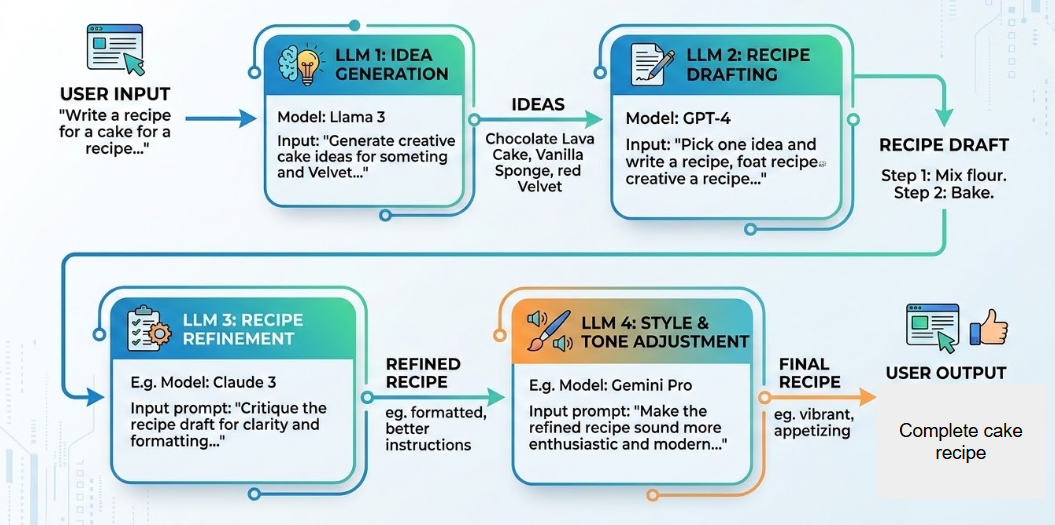
Applying it to the PagerDuty script we talked about in the introduction. The control flow looks exactly like a standard CI/CD pipeline:
GETalert data from the PagerDuty API.GETrecent logs from AWS CloudWatch.Pass both payloads to the LLM with a strict prompt: "Summarize this issue."
POSTthe LLM's response to the Slack API.
Notice who is driving the car here: your code.
If the CloudWatch API timeouts in Step 2, the script throws an exception and halts. The LLM doesn't pause, look at the 504 Gateway Timeout error, and think, "Hmm, maybe I should query Datadog instead." It never even gets invoked. The execution path is hardcoded, brittle, and entirely blind to alternatives outside its script.
For DevOps and SRE teams, however, this rigidity is often a massive feature, not a bug.
Chains give you predictability. They are highly observable. Because the execution is linear, you can easily wrap each step in standard tracing, log the exact prompts and completions, and debug failures using the exact same APM tools you already use for your microservices. When a chain fails, it fails predictably.
Most importantly, the blast radius is strictly contained. An LLM in a chain might hallucinate a bad summary, but it cannot hallucinate a brand-new API call to drop a database table. It only has the access you explicitly wired into the pipeline.
True AI Agents: The Reconciliation Loop (The Operator)#
If LLM Chains are like CI/CD pipelines, then true AI Agents are like Kubernetes Operators.
A Kubernetes Operator doesn't run a strict sequence of steps. Instead, it relies on a continuous reconciliation loop. You tell the Operator the desired state (e.g., "I want 3 replicas of this pod running"), and the Operator continuously observes the current state, reasons about the drift between the two, and acts to reconcile them.
An AI Agent works on the exact same premise, usually utilizing a framework known as ReAct (Reason, Act, Observe).
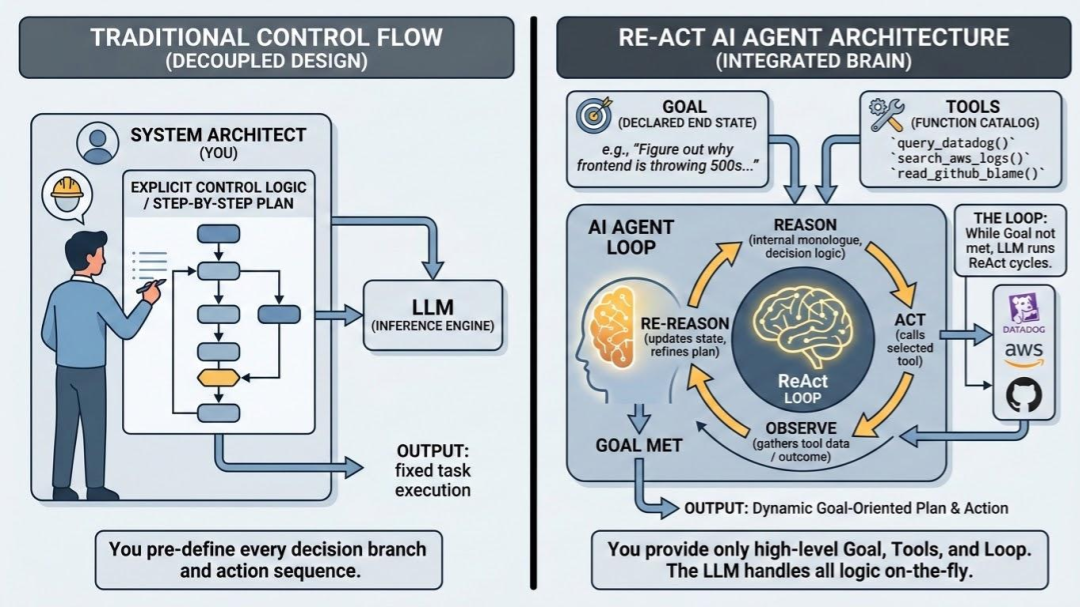
Here is the crucial architectural shift: you are no longer writing the control flow. Instead, you provide the LLM with three things:
A Goal: The desired state (e.g., "Figure out why the frontend is throwing 500s and draft a mitigation plan.")
Tools: Functions the LLM can call (e.g.,
query_datadog(),search_aws_logs(),read_github_blame()).The Loop: The while-loop that lets the LLM run until it declares the goal is met.
The LLM is now the brain of the operation, sitting inside that while-loop, orchestrating the logic on the fly.
Let's look at how an Agent would handle the same incident investigation scenario we discussed earlier:
Goal: "Investigate the PagerDuty alert regarding frontend 500 errors."
Loop 1:#
- Observe: The LLM reads the initial alert payload.
- Reason: "I see 500 errors on the
/checkoutendpoint. I should check the Datadog APM metrics for thecheckout-serviceto see if it's a code issue or a downstream dependency." - Act: The LLM calls the
query_datadog(service="checkout-service")tool.
Loop 2:#
- Observe: The tool returns high latency on queries to the
usersdatabase table. - Reason: "The database is the bottleneck. I need to check AWS RDS metrics to see if CPU is spiked or if there are slow queries."
- Act: The LLM calls the
search_aws_logs(source="rds-production")tool.
Loop 3:#
- Observe: The tool returns an unoptimized
JOINquery that was introduced in the last deployment. - Reason: "I found the root cause. A bad query was deployed. I will now generate a summary and post it to Slack."
- Act: The LLM calls the
post_to_slack()tool with the findings.
Notice the dynamic nature of this process. If the Datadog API timed out in Loop 1, the Agent could reason about that failure and decide to check CloudWatch logs instead. It handles unknown unknowns.
However, this autonomy comes at a steep cost. Agents are non-deterministic, meaning you cannot guarantee exactly how they will reach their conclusion, or how many API calls they will make along the way. They are harder to test, harder to trace using standard APM tools, and they run the risk of getting stuck in infinite loops, burning massive amounts of tokens if they repeatedly fail to understand a tool's output.
Most importantly, the security blast radius of an Agent is significantly larger. If you give an Agent write-access to your infrastructure, you are trusting a non-deterministic system with the keys to the kingdom.
The Decision Matrix: Choosing the Right Architecture#
Now that we have established the theoretical difference between the two, how do you actually decide which pattern to use in your infrastructure?
It is tempting to default to the "Agent" pattern because it feels more advanced. However, in the world of platform engineering, "advanced" usually just means "harder to maintain." You should view Chains and Agents not as a progression from bad to good, but as tools designed for fundamentally different types of workloads.
Here is a practical guide to choosing the right architecture for your DevOps use cases.
When to Build an LLM Chain#
You should build an LLM chain when you are dealing with structured automation. If the process is well-defined and the environment is highly constrained, you do not want an LLM making decisions; you just want it to process data.
- Use Case: Incident Summary Generation. Every time a PagerDuty alert fires, you want to grab the alert payload, fetch the last 100 lines from the affected service's log stream, and have the LLM write a human-readable summary to drop into Slack. The steps never change.
- Use Case: Infrastructure as Code (IaC) Linting and Explanation.
You run a security scanner (like
tfsecorcheckov) in your CI pipeline. If it fails, a chain takes the JSON output of the failure, passes it to an LLM, and comments on the pull request with an explanation of the vulnerability and the exact Terraform code block needed to fix it. - The DevOps Rule of Thumb: The Flowchart Test. If you can sit down at a whiteboard and draw a flowchart of the exact API calls required to solve the problem every single time, build a chain. Do not give the LLM the steering wheel if the road only goes in one direction.
When to Build an AI Agent#
You should reach for the Agent pattern when you are dealing with unstructured problem-solving. If the path to the solution is unknown until you start looking at the data, a linear script will fail. This is where giving the LLM a goal, a loop, and a set of tools pays off.
- Use Case: Autonomous Incident Investigation. Instead of just summarizing an alert, the goal is: "Find the root cause." The agent might start by querying Datadog APM. If it sees high database latency, it decides on its own to query AWS RDS metrics. If it finds a slow query, it cross-references GitHub to see who deployed the last migration. The agent adapts its investigation based on the clues it uncovers.
- Use Case: Cost Optimization Explorer. Goal: "Find idle resources and propose a Terraform teardown plan." The agent queries AWS Cost Explorer, identifies an expensive unused RDS instance, uses a tool to check connection metrics over the last 30 days to verify it's idle, and then searches your Terraform state file to locate the exact resource block that needs to be deleted.
- The DevOps Rule of Thumb: The Dependency Test. If step 3 depends entirely on what you discover in step 2, and step 4 might be a completely different API call depending on the outcome of step 3, build an agent.
When you build an agent, you are essentially trading predictability for adaptability. For a complex, open-ended task like digging through a microservices architecture to find a memory leak, adaptability is exactly what you need.
Architectural Trade-offs in Production#
It is one thing to run a LangChain script on your local machine; it is an entirely different beast to deploy it into a production environment where reliability, security, and budgets actually matter.
When you move from a deterministic Chain to a non-deterministic Agent, you fundamentally change the risk profile of your application. Here is how those trade-offs break down across the three pillars of production readiness.
Observability: Tracing the Black Box#
With an LLM Chain, observability is straightforward. Because the execution is linear, you can use the exact same distributed tracing tools you already rely on, like Datadog, Honeycomb, or New Relic. You open a trace, and you see exactly what happened: Step 1 executed in 200ms, Step 2 hit the OpenAI API and took 1.5s, Step 3 posted to Slack in 100ms. If it fails, you look at the span that threw the error.
With an AI Agent, traditional APM tools fall apart. When an Agent goes off the rails, you aren't just trying to figure out which function failed; you have to figure out why the LLM decided to call that function in the first place.
If your Agent gets stuck in an infinite loop -querying a database, misunderstanding the schema, failing, and querying it again - standard logs won't help you much. You need specialized LLM observability tools (like LangSmith, Arize Phoenix, or Datadog's LLM monitoring) that capture the complete ReAct loop. You have to trace the Agent's internal monologue (its "thoughts"), the exact inputs it passed to your tools, and the raw observations it got back, all contextualized within a single recursive session.
Security & Blast Radius: The Confused Deputy#
Security is arguably the biggest differentiator. An LLM Chain has a highly constrained blast radius. If you write a chain that summarizes PagerDuty alerts, you give it an IAM role with read-only access to PagerDuty and a webhook token for Slack. Even if the LLM hallucinates or falls victim to a prompt injection attack, the absolute worst it can do is post a garbage message to a Slack channel.
An AI Agent is inherently more dangerous because you are granting an LLM autonomy over tool execution.
If you give an Agent access to state-mutating tools - like restarting a pod, rolling back a deployment, or executing a database query - you are opening the door to catastrophic automated failures. AI Agents are highly susceptible to "Confused Deputy" attacks, where malicious input tricks the Agent into misusing its elevated privileges.
The golden rule for DevOps Agents: Default to read-only tools. If your Agent must take a destructive or state-altering action (like running terraform apply), you must enforce a Human-In-The-Loop (HITL) architecture. The Agent should draft the plan, but a human engineer must click "Approve" before the execution tool is invoked.
Cost & Latency: The Token Snowball#
Chains are budget-friendly and relatively fast. You make one or two bounded API calls to the LLM, passing only the context necessary for that specific step. You can accurately forecast your token burn and guarantee a response time (usually within a few seconds).
Agents burn through tokens and time. Because an Agent operates in a loop, it has to maintain context across every iteration.
Loop 1: Prompt + Tools -> Thought + Action.
Loop 2: Prompt + Tools + Loop 1 History + Observation -> Thought + Action.
Loop 3: Prompt + Tools + Loop 1 History + Loop 2 History + Observation -> Thought.
This is the "token snowball." With every step the Agent takes, the context window grows larger, which means every subsequent API call is more expensive and slower to process than the last. A complex debugging Agent might take 8 loops and 45 seconds to reach a conclusion, burning thousands of input tokens along the way. You must put hard limits on the maximum number of iterations (e.g., max_loops=5) to prevent a confused Agent from quietly bankrupting your AWS account over a weekend.
Conclusion: Walk Before You Reconcile#
We need to stop letting the marketing hype dictate our architectural terminology. Calling a simple, three-step sequential script an "AI Agent" isn't just factually incorrect; it dilutes the meaning of the pattern and leads to fundamentally flawed system designs.
If you take one thing away from this, let it be the distinction of control.
LLM Chains are the CI/CD pipelines of the AI world. You own the control flow, the steps are deterministic, and the LLM is just a highly capable text-transformation node along the way. They are predictable, easily observable, and safe. True AI Agents are the Kubernetes Operators of the AI world. You define the goal and provide the tools, but the LLM owns the control flow through a continuous reconciliation loop. They are highly adaptable, incredibly powerful, and inherently risky.
So, where do you start? Start with the chain.
Before you let a non-deterministic, autonomous loop loose to modify your Terraform state files or restructure your custom Ansible collections, build the pipeline version first. Write the Python chain. Hardcode the steps. Bind the blast radius.
Let the chain run in production until it starts breaking because it can't handle the edge cases. Once the flowchart of your script becomes too complex to maintain, you have finally found the exact right use case for an AI Agent. That is the moment you hand the LLM the wheel.
Frequently Asked Questions#
How can I quickly tell if I built an agent or a chain?
Look at your codebase. If your code executes step_1() followed by step_2() followed by step_3(), you built a chain. If your code consists of a while not goal_met: loop where the LLM's output determines the next function call, you built an agent.
Can an LLM chain use external tools and APIs?
Yes. A chain can absolutely interact with external systems like Jira, GitHub, or Datadog. The difference is who decides to use the tool. In a chain, your Python script makes the API call and hands the payload to the LLM. In an agent, you give the LLM a list of available tools, and the LLM autonomously decides which one to use based on the context.
How do I stop an AI agent from getting stuck in an infinite loop and burning my token budget?
You must enforce hard boundaries at the code level. Always set a max_iterations or max_loops limit (e.g., capping the agent at 5 tool calls per request). Additionally, implement strict timeout limits and ensure your LLM observability stack is set up to alert you on unusually high token consumption for a single trace.
Is LangChain only for building chains?
Despite the name, no. Frameworks like LangChain, LlamaIndex, and Semantic Kernel offer abstractions for both deterministic chains (like SequentialChain) and autonomous loops (like ReActAgent). The confusion in the industry often stems from developers using these frameworks' agent classes to execute simple, linear tasks that would have been better served by a basic chain.
I want to build an agent to automatically fix and deploy failing Terraform infrastructure. Is this a good idea?
You can build an agent to investigate the failure and propose a fix, but you should never allow it to deploy autonomously. For state-mutating actions (like terraform apply or kubectl delete), always implement a Human-in-the-Loop (HITL) architecture where the agent pauses and waits for a human engineer to explicitly approve the execution plan.

Indika Kodagoda
Indika Kodagoda is a Lead DevOps Engineer, AWS certification instructor, and the creator of CloudQubes. He specializes in cloud infrastructure, automation, and modern Ruby on Rails development. When he’s not deploying code or mentoring aspiring engineers, he’s usually enjoying nature and cycling local gravel paths.