
How to Harness the Power of Microlearning Even If you are Working 9+ Hours a Day
Discover how microlearning helps overworked DevOps engineers beat burnout, conquer tool sprawl, and continuously upskill in just 5 minutes a day.
format_list_bulleted
Table of Contents
22 sections
expand_more
Let’s be honest about what a typical day in ops actually looks like.
You’ve just wrapped up a solid nine-plus-hour shift. You spent the morning putting out fires in a deployment pipeline, the afternoon wrestling with infrastructure as code—maybe digging through documentation just to find the exact aws_ec2_managed_prefix_list data source you need to make a Terraform configuration work—and the evening answering Slack pings about why a staging environment is running slow.
By the time you finally step away from the terminal, your brain is absolutely fried.
Yet, hanging over your head is the unspoken industry expectation: You need to keep up. The cloud ecosystem moves at a breakneck pace. There are new services dropping constantly, the CNCF landscape is overflowing with new tools, and the pressure to continuously upskill is relentless.
We all want to grow our expertise and master new architectures, but let's call it what it is—when you are already working demanding hours, traditional professional development often feels less like career growth and more like a mandatory, unpaid second job.
The Failure of Traditional Technical Training#
We’ve all been there. You buy a highly-rated, 40-hour comprehensive video course on a new service mesh or container orchestration tool. You tell yourself, "I’m going to do an hour every night after work."
Day one, you make it through the introduction. Day two, production goes down, you work late, and you skip it. By day five, that course is just another tab you feel guilty about closing.
This isn't a failure of willpower; it is a failure of the medium. Here is why traditional learning models fall apart for overworked engineers:
The 9-Hour Wall#
The human brain is an incredible machine, but it has physical limits. After writing complex logic, debugging container networking, and managing server fleets all day, your cognitive fuel tank is empty. When you hit that "9-hour wall," your brain actively rejects deep, sustained focus. Sitting down for a dense, two-hour lecture when you are in that state isn't just difficult—it is biologically counterproductive. You might stare at the screen, but you aren't retaining a thing.
Cognitive Exhaustion and Decision Fatigue#
DevOps engineers suffer from severe context switching. In a single hour, you might bounce between reviewing application code, fixing a shell script, and adjusting an IAM role. Every time you switch contexts, you burn working memory. By the end of the day, decision fatigue has set in so deeply that even navigating an enterprise Learning Management System (LMS) feels like a monumental chore.
The Mismatch of Needs#
Intensive bootcamps and long-form video courses are designed for people who have the luxury of uninterrupted time. But operations work is entirely interrupt-driven. When you are trying to adopt a new tool or fix a specific pipeline issue, you don't need a comprehensive history of the software. You need a practical, immediate solution. Traditional training forces you to dig through hours of foundational fluff just to find the five minutes of actionable knowledge you actually need to do your job.
When your day-to-day work is a marathon, traditional learning expects you to run another 10K right after you cross the finish line. It is time we start looking for a better way to upskill without burning out.
Enter Microlearning: The Atomic Alternative#
So, if marathon study sessions are off the table and your evenings are sacred, how do you actually stay sharp without losing your mind? This is where microlearning comes to the rescue.
Instead of "macro" training—where you have to block out huge chunks of your calendar and muster up hours of focus—microlearning breaks knowledge down into atomic, bite-sized units. We are talking about highly focused lessons that take anywhere from one to ten minutes to complete.
Think of it like the difference between sitting down for a heavy, seven-course meal versus grabbing a quick, high-energy snack. You aren't trying to learn everything about a massive topic all at once. Instead, you are learning one highly useful thing: a specific AWS architecture pattern, a clever way to structure an Ansible playbook, or the mechanics of running rootless containers with Podman.
The real magic here is the paradigm shift. Traditional learning treats education like a destination—a place you have to mentally travel to by logging into a heavy portal, clearing your desk, and putting on noise-canceling headphones.
Microlearning flips that completely. It treats learning as a lightweight, friction-free tool embedded right into your existing day. It happens in the margins of your workflow. You can knock out a quick concept while waiting for a container image to build, while your Terraform state refreshes, or during those quiet five minutes before your morning stand-up.
It takes the pressure off. You do not need to find an extra two hours in your day; you just need to find three minutes.
Why Microlearning Actually Works (The Science)#
It sounds almost too good to be true, right? Can you really master complex cloud infrastructure or advanced automation by just studying in five-minute bursts? Actually, yes. In fact, both neuroscience and mathematics back this up as one of the most effective ways to learn.
Here is why your brain loves microlearning:
1. Beating the "Forgetting Curve"#
Back in the 1880s, a psychologist named Hermann Ebbinghaus discovered the "Forgetting Curve," which basically proves that we forget almost everything we learn within a few days unless we actively review it. When you cram a massive, two-hour lecture into your head, your brain dumps most of it by the weekend.
Microlearning combats this through spaced repetition. By reviewing a small, specific concept—like how a particular IAM policy evaluates permissions—frequently over time, you interrupt that forgetting curve. You are essentially shifting that knowledge from your brain's volatile, short-term memory (like RAM) into long-term, persistent storage.
2. Managing Cognitive Load#
Think of your working memory like a server with a very strict memory limit. If you try to process too many new concepts at once—say, trying to memorize the entire routing architecture of AWS Transit Gateway in one sitting—your brain hits an "Out of Memory" (OOM) error. It drops packets, and you stop absorbing information.
Microlearning respects your cognitive load limits. By giving you exactly what you can process in a single, focused session, your brain has the time to properly encode that information without getting overwhelmed. It is the human equivalent of rate-limiting your incoming traffic so the system stays stable.
3. The Power of Compounding#
This is where the math gets really exciting. If you try to find a spare two hours for learning, you might only do it once a month (if you are lucky). That’s 24 hours of exhausting study a year, with terrible retention.
But what if you spend just 5 minutes a day doing a micro-quiz or reviewing a single architecture concept?
Five minutes a day equals over 30 hours of highly focused, well-retained learning over the course of a year. It is the classic $1.01^{365}$ effect. Getting just 1% better every day yields massive compounding results. You aren't just learning a few tricks; you are systematically building formidable technical expertise, five minutes at a time, without ever feeling the strain.
Key Characteristics of Microlearning#
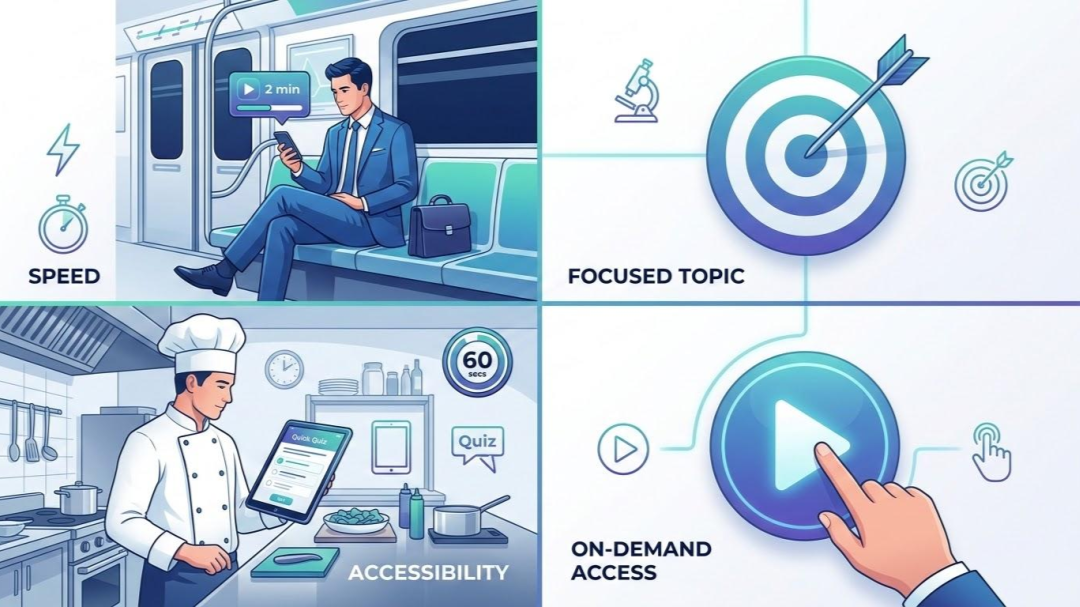
If we are going to ditch the marathon study sessions, what exactly are we replacing them with? For a piece of content to truly qualify as microlearning—especially in the ops and engineering world—it needs to hit three specific criteria.
1. Single-Objective Focus#
A good microlearning module doesn't try to boil the ocean. It has one single, hyper-focused goal. You aren't sitting down to learn "Advanced Containerization." Instead, you are taking three minutes to understand exactly how Podman handles rootless execution compared to Docker. Or, instead of a sweeping course on AWS networking, you spend a few minutes nailing down how to properly route traffic through a Transit Gateway. It’s about taking one specific architecture pattern, API call, or command, mastering it, and moving on.
2. Rich, High-Impact Media#
Because time is short, the delivery mechanism has to be incredibly efficient. Microlearning rarely looks like a dry wall of text. It leans heavily into formats that convey a lot of information instantly.
Think of a sharply drawn architecture diagram, a quick terminal recording showing how a shell script positional parameter bug behaves, or a single, scenario-based quiz question. It could even be a bite-sized interactive lab where you execute a few commands to see exactly how an Ansible playbook discovers its ansible_collections directory structure. The goal is maximum signal, minimum noise.
3. Just-in-Time Accessibility#
The best microlearning lives right where you already work. You shouldn't have to navigate through three layers of corporate single sign-on or a clunky LMS portal just to access a lesson.
It is designed to be on-demand and frictionless. Maybe it’s a quick digital flashcard you swipe through on your phone while waiting for your coffee, a quick architectural breakdown in your inbox, or a 90-second tutorial you pull up right before you write the Terraform code for a new infrastructure rollout. It is knowledge delivered at the exact moment of need.
Tailored Benefits for the DevOps Engineer#
While microlearning is a fantastic approach for almost any profession, it feels like it was practically tailor-made for the chaotic, fast-moving world of DevOps. When your daily life consists of shifting priorities and keeping complex systems alive, this atomic approach to upskilling pays massive dividends.
Here is exactly how microlearning gives DevOps engineers a competitive edge:
1. Just-in-Time Troubleshooting#
In ops, you often don't have the luxury of studying a topic weeks before you need to use it.
Learning usually happens when things are breaking. When a deployment pipeline stalls or an ingress controller starts throwing errors, you don’t need an extensive course on the history of container orchestration. You need a highly specific solution right now. Microlearning acts as an on-demand reference tool.
A focused, 2-minute troubleshooting guide or a quick scenario breakdown gives you the exact slice of knowledge you need to unblock the pipeline and get production stable without wasting hours digging through sprawling manuals.
2. Pacing with "Tool Sprawl" and Cloud Updates#
The rate of change in the cloud-native ecosystem is dizzying.
Major cloud providers drop updates constantly, and tools like Terraform, OpenTofu, Kubernetes, and Ansible evolve in leaps and bounds. Trying to stay current by reading entire changelogs or re-taking massive certification courses is impossible.
Microlearning allows you to absorb these changes incrementally. Instead of trying to master a massive tool upgrade all at once, you can spend 3 minutes understanding a new feature—like a new resource type in your Infrastructure as Code tool—and seamlessly weave it into your next project.
3. Preserving Precious Cognitive Energy#
As an engineer, your brain is your primary tool, and context-switching is its greatest enemy. Bouncing between writing a Python script, adjusting a CI/CD YAML file, and troubleshooting a network interface flap takes a massive cognitive toll. Traditional training models demand that you clear your brain and focus deeply for hours, which is exhausting.
Microlearning preserves your mental energy. Because the sessions are so brief and focused, you can easily slot them into your day without triggering the heavy context-switching fatigue that kills your afternoon productivity.
How to Do Microlearning Properly (Best Practices)#
It is easy to nod along and say, "Yes, I should learn in smaller chunks." But how do you actually build this into a chaotic week without it becoming just another to-do list item you end up ignoring?
Here is how you make microlearning stick:
1. Habit Stacking#
Don’t try to carve out a brand new "learning time" in your calendar. You will inevitably overwrite it the second a high-priority ticket comes in. Instead, attach a 3-minute learning habit to something you already do every single day.
Knock out a quick architecture review while waiting for a Terraform apply to finish. Read a bite-sized concept while your morning coffee brews, or while you wait for a heavy container image to build. By tying the learning to an existing, unavoidable trigger, it becomes automatic.
2. Active Over Passive#
Watching a 5-minute video is okay, but actively solving a problem is significantly better. Passive consumption evaporates quickly. Look for microlearning formats that force your brain to make a decision.
Engage with a scenario-based quiz. Try to spot the bug in a short shell script snippet. Figure out why a specific Ansible task might fail before you look at the answer. Active recall builds much stronger neural pathways than just listening to someone else explain a concept.
3. Curation Over Consumption#
The internet is full of noise. If you spend 15 minutes searching for a 5-minute lesson, you have entirely defeated the purpose.
Find a highly curated source of information that aligns with your specific stack—whether that is AWS, infrastructure as code, or containerization—and stick to it. Let an expert do the heavy lifting of filtering the content so you can focus your limited energy purely on absorbing the knowledge.
Why not start now#
Sustainable career growth in this industry shouldn't require you to sacrifice your weekends, your evenings, or your sanity.
You don't need to completely overhaul your life or miraculously find a way to work fewer hours to become a sharper engineer. You just need to change the unit of learning.
By embracing microlearning, you shift from exhausting educational marathons to high-impact, frictionless sprints. You respect your cognitive limits, you retain significantly more information, and you build compounding technical expertise right in the middle of your daily workflow.
Ready to stop cramming and start compounding?
Don't wait for your production schedule to magically clear up—it won't. Start your next shift with just one high-yield concept. Subscribe to the CloudQubes daily exam question to continuously build your cloud architecture and infrastructure expertise, 5-minutes at a time.

Indika Kodagoda
Indika Kodagoda is a Lead DevOps Engineer, AWS certification instructor, and the creator of CloudQubes. He specializes in cloud infrastructure, automation, and modern Ruby on Rails development. When he’s not deploying code or mentoring aspiring engineers, he’s usually enjoying nature and cycling local gravel paths.