
Hacking the Brain's Bandwidth: The Psychology of Microlearning
Discover the psychology behind microlearning. Learn how cognitive load, spaced repetition, and the Zeigarnik effect work together to permanently wire the brain.
format_list_bulleted
Table of Contents
6 sections
expand_more
We have a fundamental misunderstanding of how the human brain processes information.
When designing training modules, online courses, or educational platforms, we tend to treat human memory like a hard drive—assuming we can simply execute a write operation, dump a gigabyte of data into long-term storage during a single 60-minute session, and expect it to be perfectly retrievable on demand.
In reality, human memory is not a storage drive; it is a highly restrictive biological filter.
The Mismatch Between Traditional Learning and Human Biology#
The human brain is simply not wired for marathon, passive lectures. When forced to sit through a massive, monolithic lesson, the brain doesn't just absorb the data slower—it actively starts dropping packets. The learner spends more cognitive energy trying to stay focused, organizing the structure of the lecture, and filtering out the noise than they do actually encoding the core concepts.
This is why traditional, long-form learning so often results in the illusion of competence. We feel like we are learning because we are consuming content for hours, but the moment the session ends, actual retention evaporates.
Microlearning is not just a modern trend designed to accommodate shrinking attention spans. It is a structural correction. By delivering information in targeted, highly compressed bursts, microlearning is the only educational delivery method that aligns perfectly with the hard limits of cognitive psychology. It stops fighting our biological bottlenecks and starts designing for them.
Miller's Law and Cognitive Bottlenecking#
To understand why traditional education models fail, you have to look at the strict limitations of human working memory.
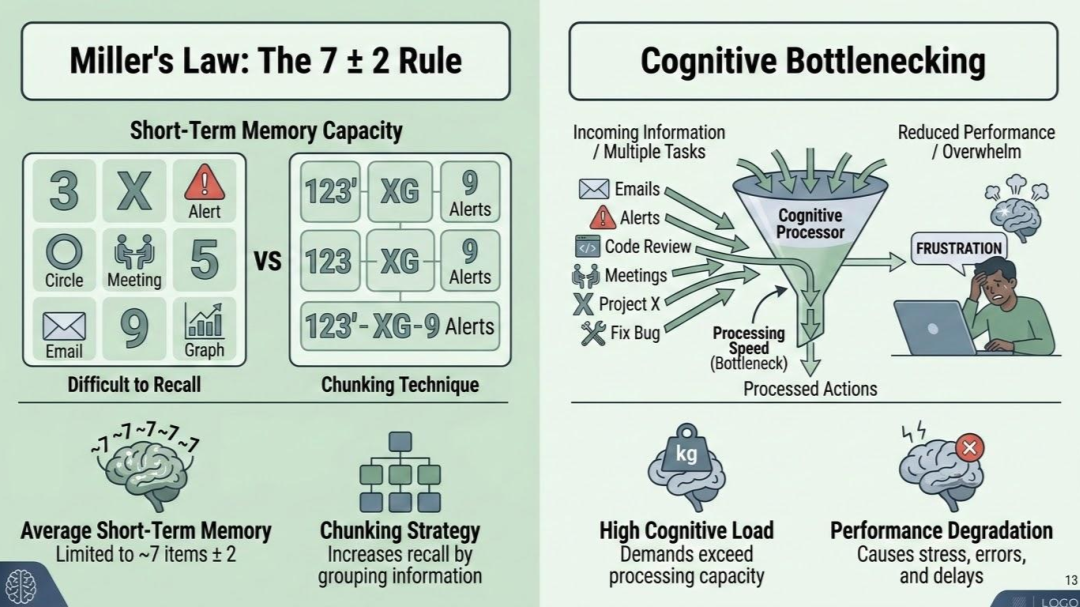
In 1956, cognitive psychologist George A. Miller published one of the most highly cited papers in psychology, proposing that the average human working memory can hold only 7 +/- 2 objects at any given time. More recent cognitive research suggests that when dealing with complex or novel information, that number actually drops to roughly four to five distinct items.
Think of working memory as the brain's RAM. It is a highly volatile, strictly limited buffer.
When a learner is subjected to an hour-long training module or a dense, multi-chapter textbook, that buffer is immediately flooded. Cognitive Load Theory dictates that the brain only has so much processing power to allocate. In long-form formats, a massive percentage of that power is wasted on extraneous load—the mental energy spent filtering out fluff, deciphering complex formatting, navigating long tangents, and simply trying to maintain focus. By the time the brain attempts to process the actual core concept (the germane load), the system is already overwhelmed, and the data is dropped.
Microlearning solves this bandwidth issue through aggressive, systematic "chunking."
By isolating a single, hyper-focused learning objective into a two- to five-minute module, you intentionally keep the cognitive load well below the brain's buffering limit. There is no extraneous noise to filter. The brain doesn't have to waste energy organizing a sprawling syllabus; it only has to process the one concept directly in front of it. This focused allocation of mental energy allows for near 100% absorption, passing the data cleanly from the working memory buffer into long-term storage.
The Forgetting Curve and the Science of Spaced Repetition#
Even if you successfully bypass the working memory bottleneck, you immediately face a second biological hurdle: memory decay.
In the late 19th century, psychologist Hermann Ebbinghaus quantified this phenomenon with the Forgetting Curve. His research demonstrated a brutal reality of human biology: without active reinforcement, the brain discards roughly 50% of passively acquired information within a single hour, and up to 90% within a few days.
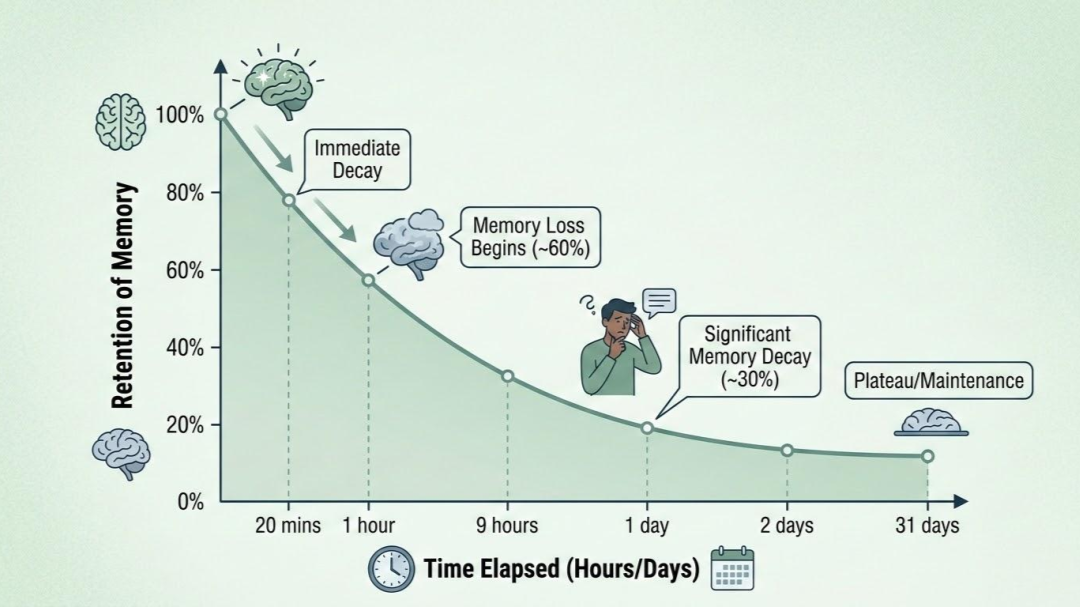
When learners cram for an exam or binge a long-form course, they create a temporary illusion of mastery. Because the information is currently sitting in their short-term memory, they feel fluent and capable. However, without recurring recall triggers, the brain quickly prunes those fragile neural pathways, deeming the massive, one-time influx of data irrelevant for long-term survival.
To permanently encode information, you have to leverage the Spacing Effect.
The Spacing Effect works by introducing intentional cognitive friction into the learning process. Instead of massing information together in one sitting, you allow a memory to slightly fade, and then force the brain to retrieve it. That struggle to recall the information is not a sign of failure; it is the exact mechanism that thickens and strengthens the neural pathway.
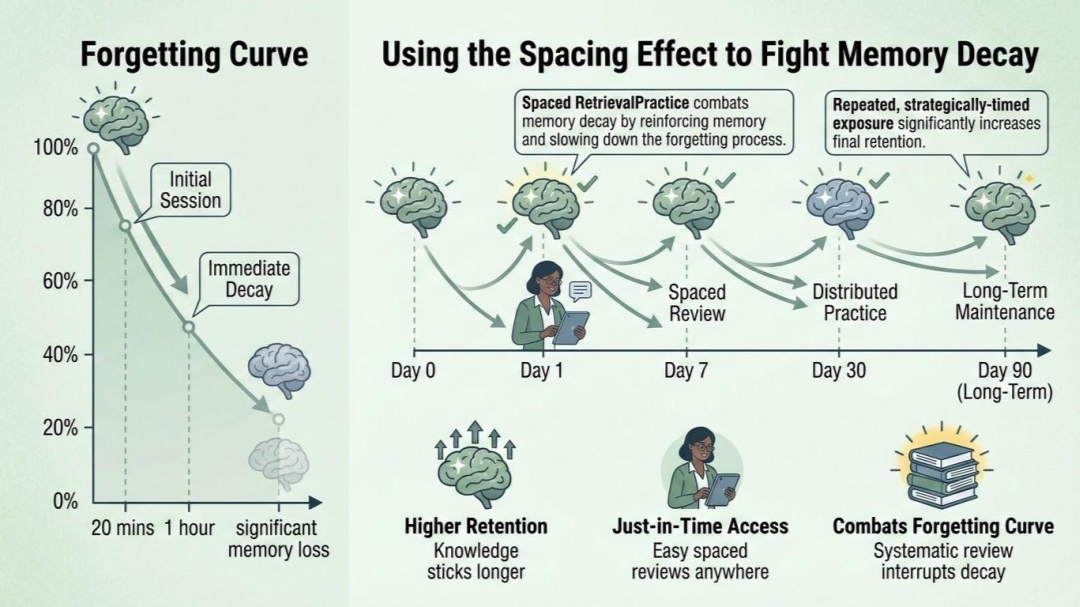
This is where the psychological power of a daily streak becomes critical. When a learning system delivers a small, recurring trigger—such as a single, targeted question delivered straight to a learner's inbox every morning—it forces them to retrieve the concept just as it is beginning to decay. By actively interrupting the forgetting curve on a daily basis, this microlearning habit repeatedly signals to the brain that the data is essential, successfully pushing it from volatile short-term memory into permanent, long-term storage.
The Dopamine Loop and the Psychology of "Small Wins"#
To build an educational system that actually works, you have to account for human motivation—and biologically, motivation is governed by dopamine. While often misunderstood simply as a "pleasure" chemical, dopamine is actually the neurotransmitter responsible for reward prediction and habit formation. It fires when we set a goal, anticipate the outcome, and successfully complete the task.
Traditional learning architectures are fundamentally broken when it comes to the dopamine loop.
When a learner enrolls in a massive, 40-hour curriculum, the ultimate reward (mastering the skill or passing the certification) is delayed by weeks or months. Staring at a dashboard that says "12% Complete" after hours of grueling study does not trigger a dopamine response; it triggers cognitive fatigue. The finish line is simply too far away to sustain daily motivation, which is exactly why long-form e-learning courses suffer from such catastrophic abandonment rates.
Microlearning rewires this behavior by shrinking the feedback loop.
By designing educational content around modules that take less than five minutes, you create immediate, achievable goals. Every single time a learner finishes a short concept or clicks "submit" on a daily question streak delivered to their inbox, they experience a discrete psychological "win."
This micro-completion triggers a minor, localized dopamine release. It signals to the brain that the effort was worth the reward. By stacking these small wins day after day, you transform education from a heavy, exhausting chore into a frictionless, habit-forming loop. The learner stops relying on sheer willpower to open a textbook and instead starts craving the daily psychological reward of making measurable progress.
The Zeigarnik Effect and Active Recall#
In the 1920s, psychologist Bluma Zeigarnik observed a fascinating quirk of human memory while watching waiters in a busy café. She noticed that the staff could remember complex, unpaid orders perfectly, but forgot them the instant the bill was settled. This cognitive phenomenon—where the brain remembers uncompleted or interrupted tasks significantly better than completed ones—became known as the Zeigarnik Effect.
Traditional, passive learning completely fails to leverage this mechanic. When you sit back and watch a 30-minute video lecture, your brain considers the consumption of the video as the task itself. The moment the video ends, the task is checked off as "complete," and the brain immediately begins purging the data to free up bandwidth.
Microlearning, specifically when delivered as a challenge, weaponizes the Zeigarnik Effect.
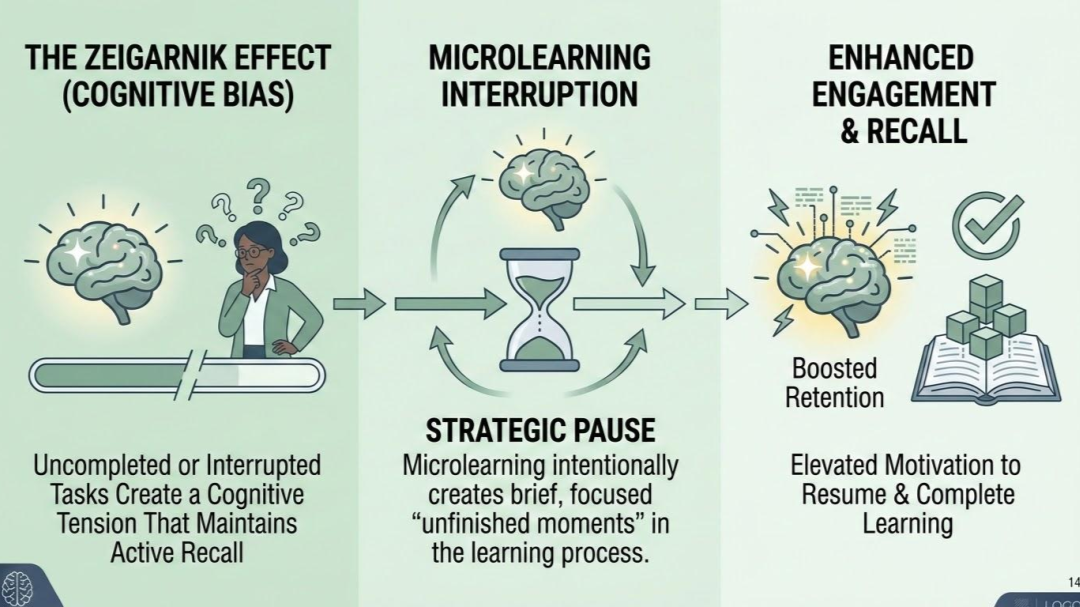
When a learner receives a daily scenario-based question in their inbox, it creates an immediate cognitive itch. The task isn't just to read; it is to solve. Because the problem is presented but left open, the brain keeps the underlying concepts loaded in working memory. The task remains uncompleted until the learner engages with it.
This open loop forces the learner into Active Recall. Instead of passively absorbing information, they have to actively search their own memory banks to retrieve the correct technical context and apply it to the problem. The brain remains actively engaged with the concept until the learner proves they understand it and finally closes the loop. This brief, intense friction of retrieving the answer cements the knowledge far deeper than simply reading the solution ever could.
Conclusion: Designing for the Human Operating System#
For decades, the educational industry has measured success by the volume of content it can broadcast. But as the cognitive science shows, effective education isn't about how much information you can push toward a learner; it is strictly about how much information their brain can successfully encode. The era of the marathon lecture, the exhausting weekend cram session, and the monolithic textbook is failing because it fundamentally ignores how human biology actually works.
Microlearning on the other hand, seamlessly match with the expectations of your brain's operating system. It does not demand sacrificing your weekends, or your other aspects of life.
By delivering knowledge in hyper-focused chunks and demanding relentless active recall, microlearning helps you learn efficiently leveraging the brain's innate mechanics

Indika Kodagoda
Indika Kodagoda is a Lead DevOps Engineer, AWS certification instructor, and the creator of CloudQubes. He specializes in cloud infrastructure, automation, and modern Ruby on Rails development. When he’s not deploying code or mentoring aspiring engineers, he’s usually enjoying nature and cycling local gravel paths.