
From Prompting to Autonomous Agents: The 5 AI Application Architectures
Architecting an AI app in 2026? Discover the exact infrastructure requirements and trade-offs for RAG, Autonomous Agents, Workflows, and Fine-Tuning.
format_list_bulleted
Table of Contents
22 sections
expand_more
We have moved past the initial honeymoon phase of AI applications.
The "v1" of building an AI application—taking a user’s text string, slapping it into an API call to a frontier model, and printing the output on a screen—has quickly become the baseline commodity. For simple scripts or quick prototypes, that’s fine. But when you are building for enterprise scale, that approach falls apart fast.
As cloud engineers and architects, our challenges have shifted. We are no longer asking if the model is smart enough to answer; we are asking how to feed it the right data at the right millisecond, how to control its cost, and how to stop it from going into an infinite loop when it hits an error.
To solve this, a distinct set of software architecture patterns has emerged.
When you design an AI-powered system, you are essentially positioning your application on a spectrum of autonomy. On one end, you have traditional, rigid, code-driven systems where you control every single boundary condition. On the other end, you have completely autonomous agents that are given a goal, a set of tools, and the freedom to chart their own path to a solution.
Choosing where your application sits on this spectrum isn’t just a developer preference—it changes your entire cloud infrastructure footprint. Moving from a basic chatbot to an autonomous system changes how you manage database scaling, network isolation, IAM permissions, and compute budgets.
The goal of this article is to map out the five major AI application architectures dominating the industry, break down their core components, and give you the framework to choose the exact pattern your workload requires.
#1: Stateless Prompting: The "Hello World" of AI#
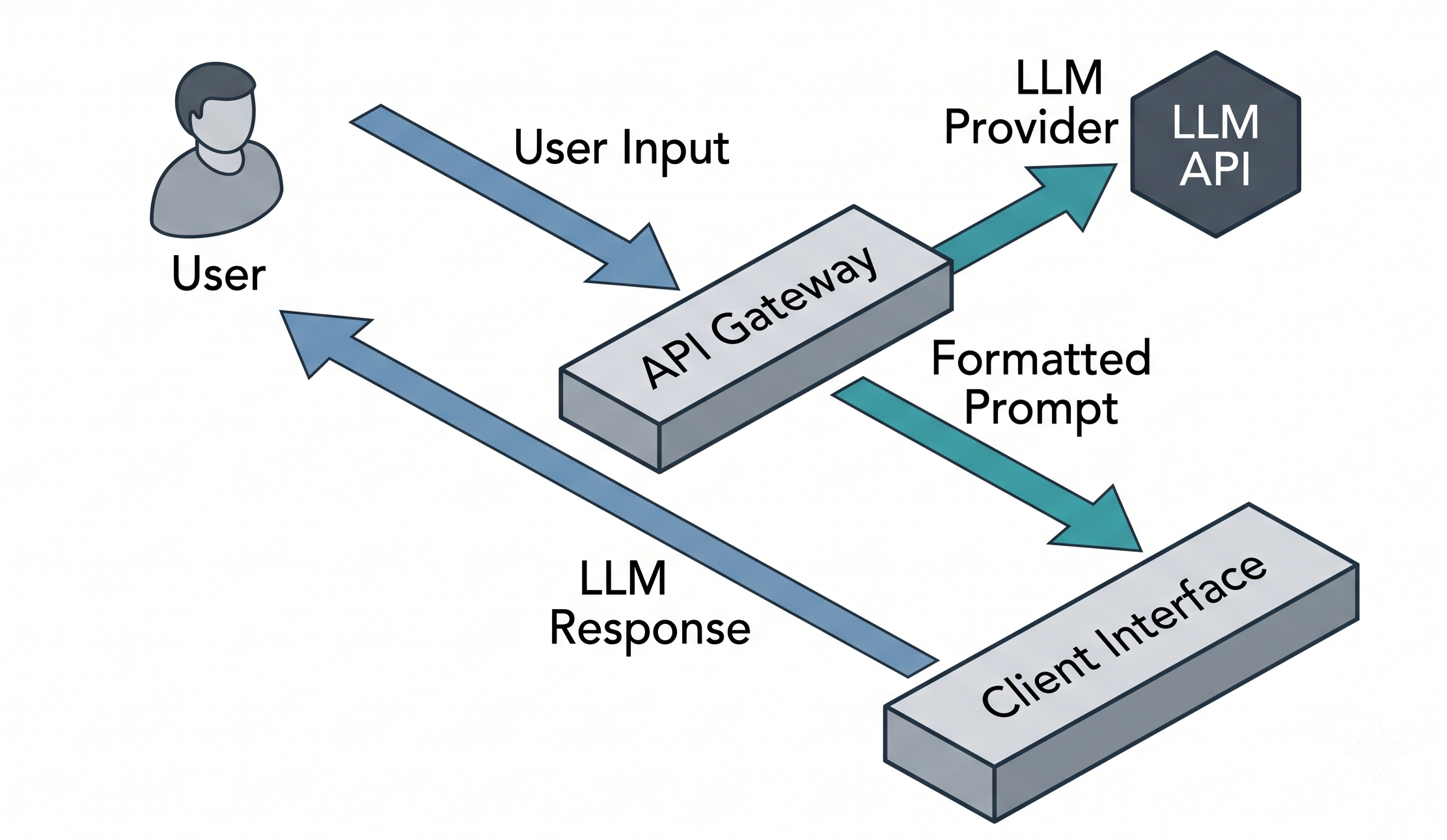
Every journey into AI engineering begins here. Stateless prompting is the most straightforward, minimal architecture possible for an AI application. Structurally, it mirrors a traditional client-server request-response cycle: a client submits data, a backend service packages that data into a structured string (the prompt), forwards it to an LLM provider’s endpoint, and returns the response.
[ User Input ] ---> ( Backend Service / API Gateway ) ---> [ LLM Provider API ]
                                                                   |
[ User Output ] <--- ( Backend Service / API Gateway ) <--- [ Response String ]
The defining characteristic of this pattern is in the name: stateless. The LLM itself has no memory. It does not remember the request you made 30 seconds ago, nor does it retain any data from other users. Every single API call is a clean slate.
The Infrastructure Footprint#
From a cloud engineering perspective, this is the easiest architecture to deploy and scale. Because the application logic is completely stateless, your infrastructure requirements are minimal:
- Compute: Lightweight, ephemeral compute like AWS Lambda, Google Cloud Functions, or Azure Functions handles the API routing perfectly.
- Storage: Zero database requirements for the AI layer itself. You don't need to manage vectors, cache historical states, or sync session data.
- Networking: Standard outbound HTTPS traffic to the model provider (or an internal private endpoint if you are using hosted models like AWS Bedrock or Azure OpenAI within your VPC).
The Boundary Conditions: When It Fails#
While stateless prompting is incredibly cost-effective and low-maintenance, its limitations are severe when applied to complex workflows:
- No Historical Context: If a user is having a multi-turn conversation, a truly stateless architecture forces the developer to manually append the entire historical chat log into the prompt window of every single new request. As the conversation grows, your token consumption scales linearly, driving up costs and latency.
- Knowledge Isolation: The model only knows what it was trained on. If you ask a stateless prompt to analyze an internal database schema or troubleshoot a proprietary deployment error, it will either fail entirely or, worse, confidently hallucinate an incorrect answer.
Where It Still Wins#
Despite these limitations, stateless prompting remains the ideal architectural choice for narrow, high-throughput utility tasks. If you need to evaluate the sentiment of an incoming support ticket, translate a block of user text, format raw log data into structured JSON, or summarize a single uploaded document, building anything more complex than a stateless prompt is over-engineering. It is fast, scalable, and keeps your operational overhead at absolute zero.
#2: Retrieval-Augmented Generation (RAG): The Enterprise Standard#
If stateless prompting is a closed-book exam, Retrieval-Augmented Generation (RAG) is an open-book test with an incredibly fast librarian.
As we discussed in the last section, LLMs are isolated. They don't know your company's vacation policy, they don't know your database schema, and if you ask them about it, they will often confidently hallucinate a completely wrong answer.
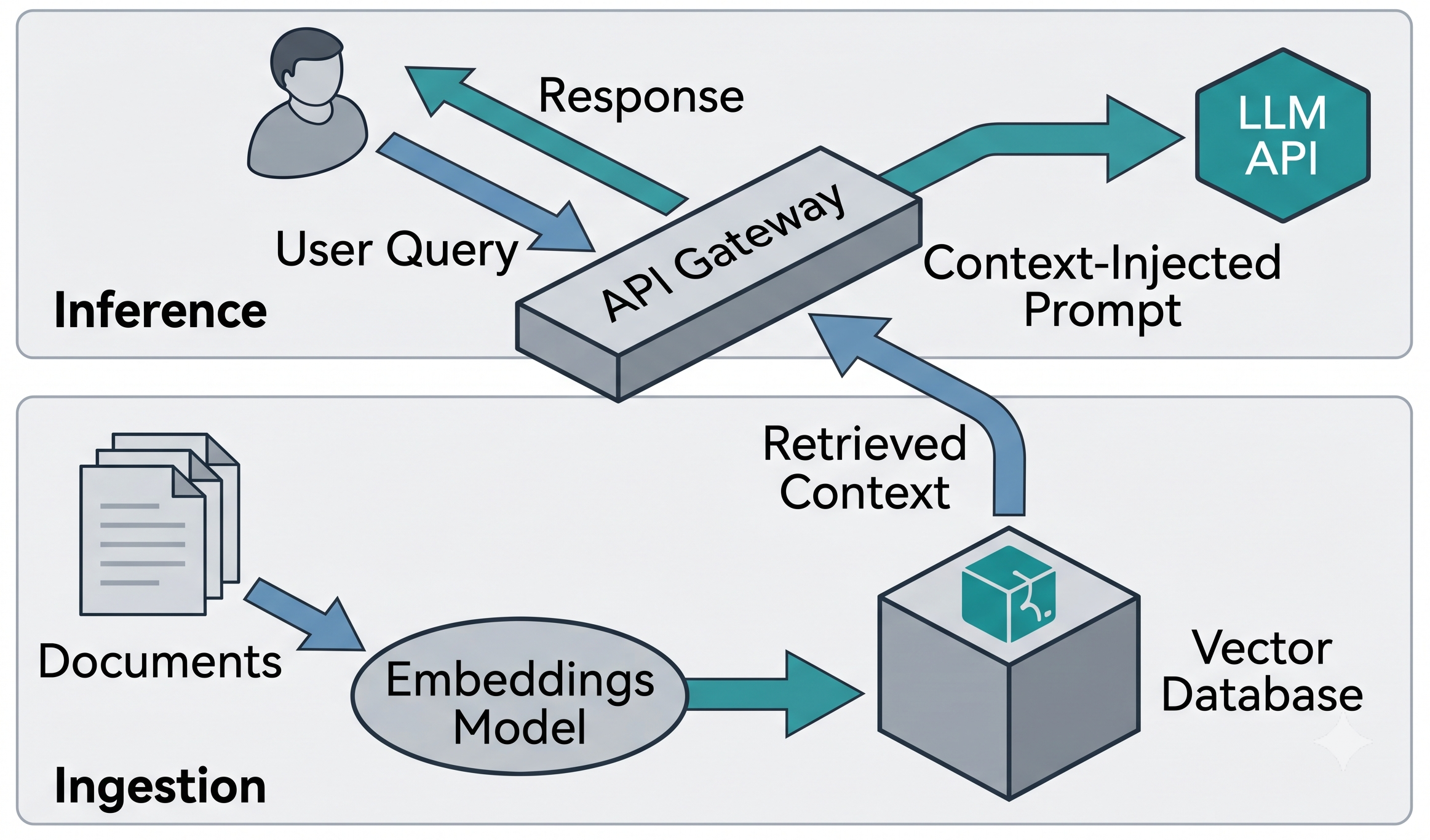
RAG solves this by connecting large language models to your external, proprietary knowledge sources precisely at the moment of inference. Instead of trying to cram your entire company's knowledge base into the model's weights through expensive retraining, you retrieve the specific facts needed and hand them to the model just-in-time.
The Textbook Architecture#
In a basic proof-of-concept, the RAG architecture is straightforward:
- Ingestion & Chunking: You take your unstructured data (PDFs, wikis, Slack logs) and break them into smaller, retrievable blocks of text called "chunks".
- Embedding: A specialized embedding model translates those chunks into dense arrays of numbers (vectors) that capture their semantic meaning.
- The Vector Database: You store these vectors in a specialized database optimized for high-speed similarity search.
- Retrieval & Generation: When a user asks a question, you embed their query, search the vector database for the top matches, and inject those matched chunks into the prompt alongside the original question. The LLM then generates an answer strictly based on that provided context.
The 2026 Production Reality#
Any developer can build the textbook flow above in an afternoon, and it will look amazing in a 15-minute stakeholder demo. But in 2026, we know that naive RAG architectures rarely survive contact with production users.
To build an enterprise-grade RAG system today, cloud architects have to implement a much more rigorous stack:
- Infrastructure Scaling: For many teams, starting with pgvector on an existing PostgreSQL instance is the right move, comfortably handling up to roughly 50 million vectors. However, once latency spikes or vector counts cross that ceiling, architects typically migrate to dedicated vector infrastructure like Pinecone, Qdrant, or Weaviate.
- Hybrid Retrieval & Reranking: Pure semantic vector search often misses the mark on specific keywords or acronyms. Production systems now default to Hybrid Retrieval, which combines dense vector search with traditional sparse keyword search. Once the top 50 documents are retrieved, a specialized Reranker model (like a cross-encoder) re-scores and reorders them. Adding a reranking step is currently considered the highest-ROI architectural change you can make to improve RAG quality.
- Context Assembly: You can't just dump chunks into a prompt randomly. Models suffer from the "lost in the middle" phenomenon, meaning they pay attention to the beginning and end of a prompt but ignore the center. Production RAG pipelines must intentionally front-load the most critical chunks.
- Governance and Access Control: This is the ultimate enterprise hurdle. If a junior developer asks the RAG bot about salaries, the system must not retrieve chunks from the CFO's private folder. Real RAG architectures require strict permission inheritance, meaning the system filters documents at the retrieval layer based on the querying user's exact IAM or Active Directory privileges.
Why RAG Wins the Enterprise#
RAG is the undisputed enterprise standard right now for three major reasons. First, it drastically reduces compute and DevOps overhead because you can update your knowledge base continuously without ever retraining the LLM. Second, it practically eliminates hallucinations on knowledge-intensive tasks by forcing the model to stay grounded in the provided text.
But most importantly, RAG provides source transparency. Because the generation is based on retrieved chunks, every answer can be cited with a direct link back to the source document. In regulated industries like finance, healthcare, or legal, that auditability isn't just a nice-to-have; it is a hard requirement.
#3: Workflow Orchestration & Prompt Chaining#
If you have ever tried to get an LLM to perform five complex instructions in a single prompt, you already know how it ends: the model does the first two perfectly, hallucinates the third, and completely ignores the last two.
When a task gets too complicated for a single API call, but you still need absolute, predictable control over how it executes, you don't build an autonomous agent—you build a workflow.
The Philosophy: Predictable AI#
In a workflow orchestration architecture, the LLM is not making decisions about how to solve the problem. Instead, the human developer defines a rigid, deterministic backbone (usually in code), and the AI is only invoked to perform specific, isolated tasks at designated steps along that path.
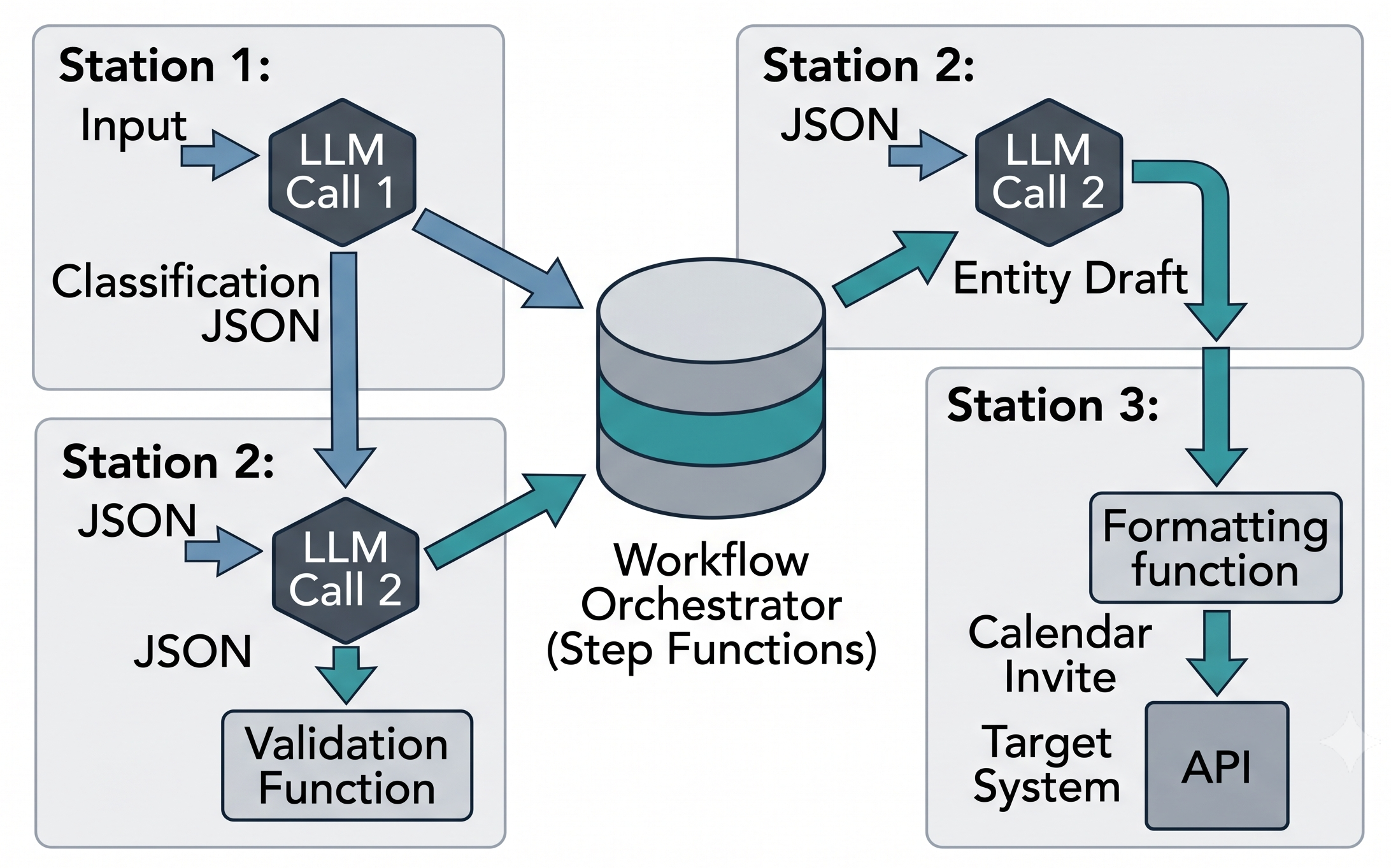
The most foundational pattern here is Prompt Chaining. Rather than asking the model to do a massive task in one leap, you break it down into an assembly line.
- Step 1: An LLM extracts names and dates from an unstructured email and outputs them as a strict JSON object.
- Step 2: A Python script validates that the JSON matches your schema.
- Step 3: A second LLM takes that validated JSON and uses it to draft a calendar invite.
Because each step is isolated, it is testable, debuggable, and vastly more reliable than trying to stuff it all into one massive prompt.
Beyond the Chain: Advanced Routing and Orchestration#
In a production cloud environment, you rarely stop at a simple, linear chain. Modern workflows introduce complex routing and parallelization.
For example, you can implement a Supervisor Router pattern. When a user submits a query, you first hit a fast, incredibly cheap model (like Claude 3 Haiku or Llama 3 8B) whose only job is to classify the intent.
- If the query is a simple password reset, the router sends it to a basic Python script.
- If the query requires deep data analysis, the router forwards it to a massive, expensive model (like GPT-5.6 or Claude 3.5 Opus). By routing requests intelligently, you can often cut your inference costs by 40-60% without sacrificing capability.
The Infrastructure Layer#
While you can write these workflows as simple Python scripts using libraries like LangChain or LlamaIndex, that approach often breaks down in production. If Step 4 of your chain fails because of a network timeout, a basic script loses the entire state, costing you the token spend of Steps 1-3.
This is why cloud architects lean heavily on dedicated state-machine orchestrators. Tools like AWS Step Functions, Temporal, or graph-based frameworks like LangGraph are built specifically to handle these distributed failures. If a step crashes, these orchestrators pause the workflow, wait for the network to recover, and retry exactly from where it left off, ensuring that your AI pipelines are as resilient as your traditional microservices.
#4: Agentic AI: The Autonomous Architecture#
If workflow orchestration is a train running on pre-laid tracks, Agentic AI is an off-road vehicle navigating by GPS.
This is the bleeding edge of enterprise AI right now. In the previous section, we defined workflows as systems where the human writes the control logic and the LLM just performs isolated tasks. In an agentic architecture, you flip that dynamic completely: the LLM is the control logic.
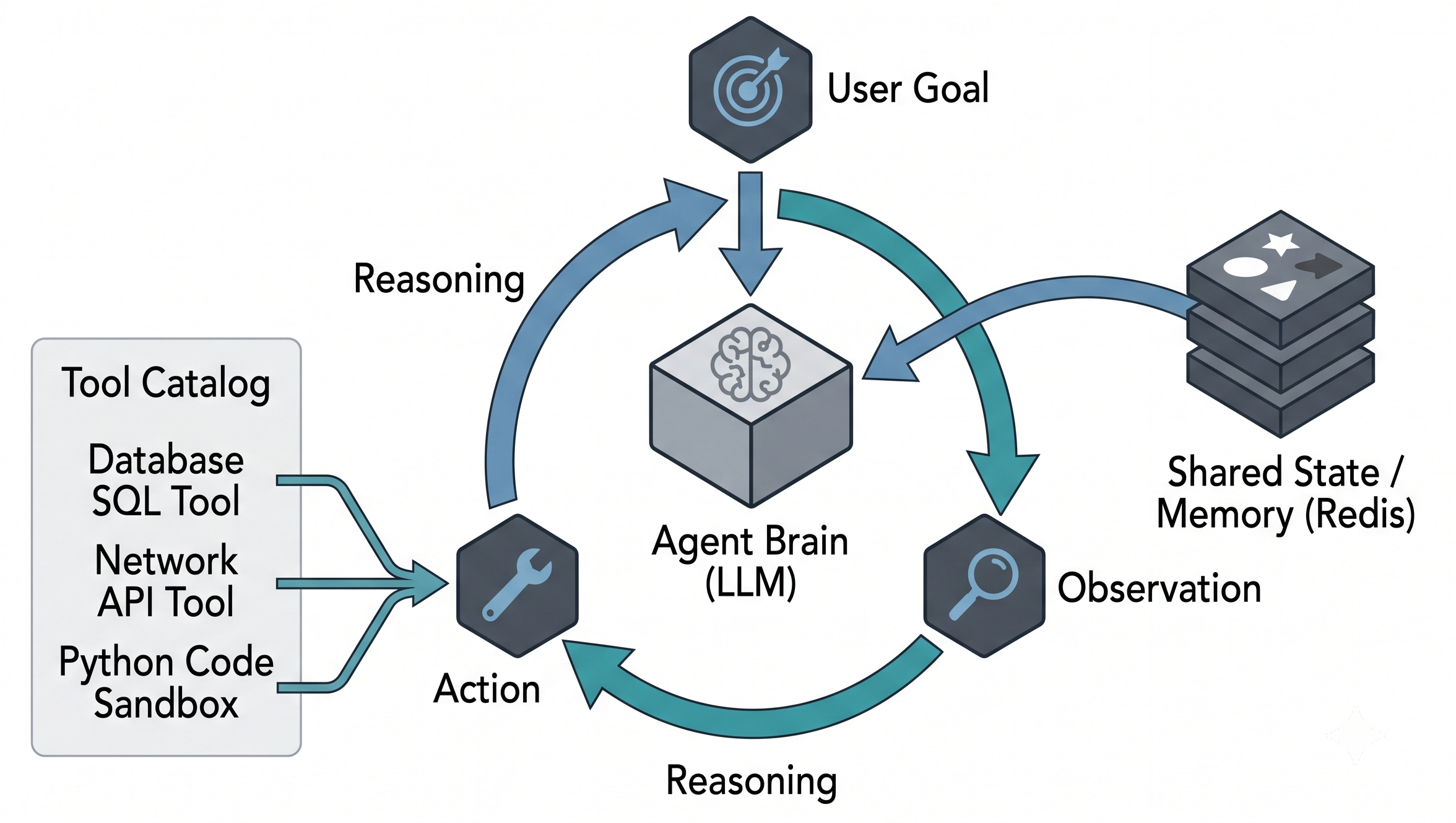
Instead of hard-coding a step-by-step pipeline, you give the system a high-level goal, a catalog of tools, and the autonomy to figure out how to bridge the gap.
The Paradigm Shift: Reason and Act (ReAct)#
At the core of most autonomous systems is a reasoning loop, often based on the ReAct (Reason + Act) pattern.
When a request comes in, the agent doesn't just blindly execute a script. It pauses to reason about what it needs to do, selects a tool, acts by executing that tool, observes the output, and then reasons about what to do next. If a tool fails or returns an unexpected error, a well-designed agent won't just crash—it will read the error log and dynamically try a different approach.
The Architecture Components#
Building this requires a completely different infrastructure stack than standard prompting:
- The Brain (LLM): You can't use small, cheap models for this. Orchestrating an agent requires heavy reasoning, planning, and strict adherence to JSON schemas. You need frontier models like Claude 3.5 Sonnet, GPT-5.6, or Gemini 1.5 Pro acting as the central cognitive engine.
- The Tool Catalog: The agent needs hands. You expose APIs, database connectors, or CLI commands to the agent as documented functions. For example, if you are automating network remediation, you might give the agent a tool to query the fault statuses across a fleet of 300 infrastructure switches, another to read the system logs, and a third to gracefully restart a failed monitoring daemon via Podman. The agent decides which to use and when.
- State & Persistent Memory: Because the agent is running in loops, it needs a place to store its scratchpad and historical context. This demands robust external state management, often leveraging high-speed caches (like Redis) or cloud-native managed memory banks, ensuring the agent doesn't lose its train of thought during a multi-minute operation.
The Trade-Offs: Power vs. Chaos#
The upside of agentic architectures is massive. They can solve incredibly complex, dynamic problems that are impossible to map out in a static workflow.
The downside? They are inherently unpredictable.
- Latency: A user request might take three seconds if the agent solves it in one loop, or three minutes if the agent needs to try four different tools.
- Infinite Loops: If an agent gets confused, it can enter a loop of repeatedly calling the same tool and failing, burning through massive token budgets in minutes before timing out.
- The Blast Radius: This is the ultimate cloud engineering challenge. If you give an autonomous agent the ability to execute code or change infrastructure, you must wrap it in draconian security boundaries. Containerized sandboxes, isolated VPCs, and strict least-privilege IAM boundaries aren't just best practices here; they are the only things standing between a helpful AI and an automated production outage.
#5: Fine-Tuning: Modifying the Weights#
There is a massive misconception in enterprise AI that trips up cloud teams every single day. When a model doesn’t know a company’s proprietary data, the instinct is often, "We need to fine-tune it on our internal wiki."
That is usually a very expensive mistake.
As the industry has matured in 2026, the consensus is clear: fine-tuning is not a knowledge injection mechanism; it is a behavioral pattern-modification mechanism. If you need the model to know what your new pricing sheet looks like, you use RAG. But if you need the model to change its behavior, tone, or output structure, you use fine-tuning.
The Architecture: A Full MLOps Pipeline#
Fine-tuning isn't just an application routing pattern—it requires a complete architectural shift into an MLOps pipeline. You are permanently adapting the model’s internal weights through supervised training.
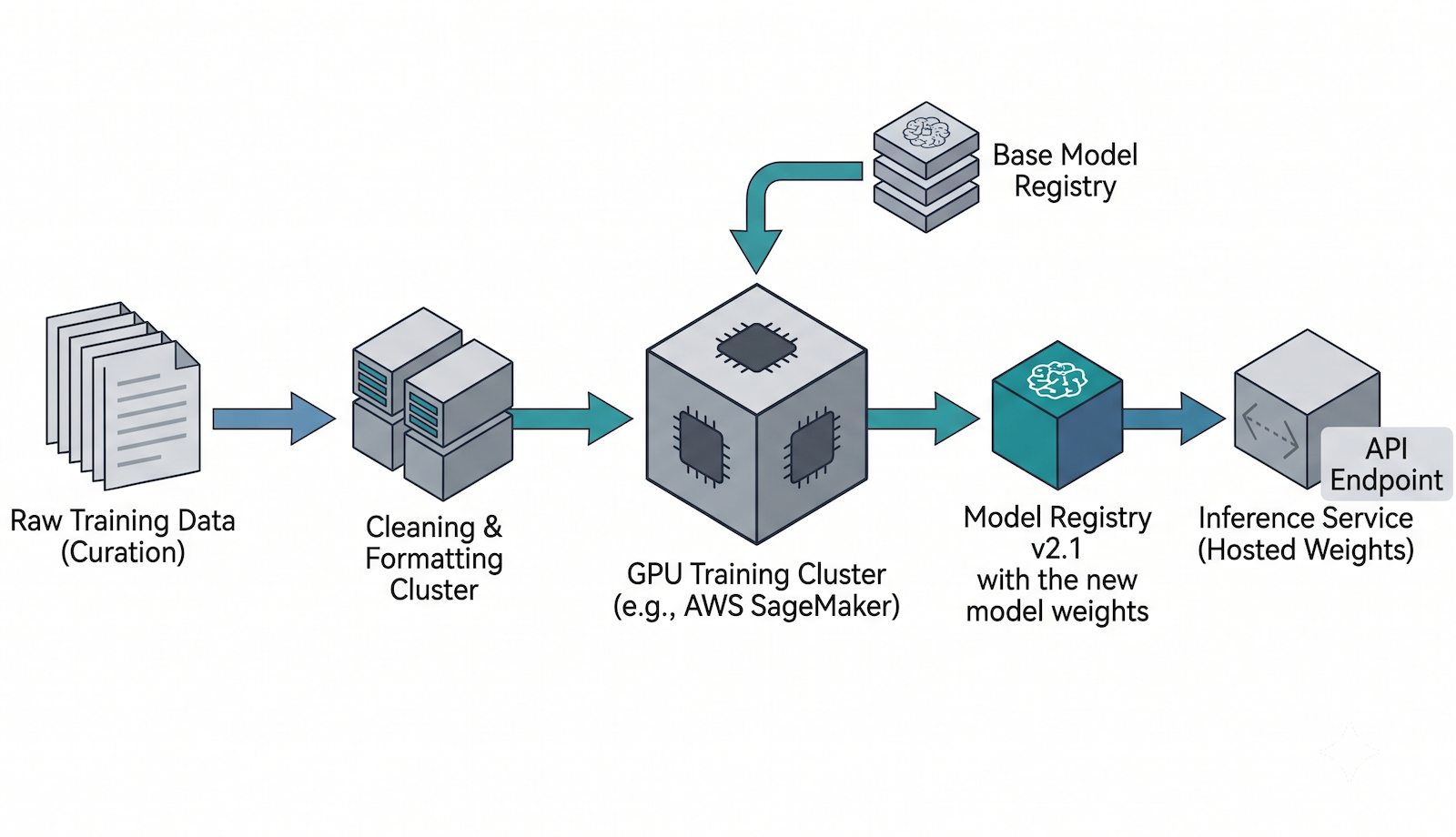
Instead of just managing API gateways and Lambda functions, your cloud infrastructure now has to accommodate:
- Data Curation Pipelines: Extracting, cleaning, and formatting thousands of perfect input/output examples.
- Training Compute: Spinning up GPU clusters (like AWS SageMaker, GCP Vertex AI, or Azure ML) to run the actual training jobs.
- Model Registries: Versioning the newly minted model weights and deploying them to dedicated inference endpoints.
The good news? The economics of this architecture have shifted favorably. While the cost to train massive frontier models from the ground up continues to rise, the cost of fine-tuning existing open-weight models has fallen sharply.
When You Actually Need It#
You absorb the infrastructure overhead of fine-tuning when prompting and RAG fail to deliver structural consistency.
For example, if you are building an automated backend service where the LLM absolutely must return a complex, nested JSON payload every single time without hallucinating a random conversational prefix, prompting often isn't reliable enough. However, using techniques like LoRA (Low-Rank Adaptation) trained on roughly 1,000 JSON-formatted examples is highly effective at baking that behavior directly into the model.
Fine-tuning is also the go-to architecture for deep domain adaptation—like teaching a model the highly specific phrasing conventions of a legal brief or the exact terminology of a medical diagnostic report.
The Compliance Risk: The Right to be Forgotten#
For cloud architects, fine-tuning introduces a severe governance risk that RAG completely avoids: data permanence.
Fine-tuning is incredibly risky in environments subject to strict privacy laws like the GDPR's "right to be forgotten". In a RAG architecture, if a user requests their data be deleted, you simply delete their vector from your database, and the AI instantly stops referencing it. But if that user's sensitive data gets baked into the model's neural weights during a fine-tuning run, removing that influence is technically difficult and often requires completely retraining the model from scratch.
The Rule of Thumb:
If your data is dynamic, factual, or subject to strict compliance deletion, build a RAG architecture. If your task requires a strict format, repeatable domain expertise, and the data is stable, invest in the fine-tuning pipeline.
Choosing Your Pattern#
The most common mistake engineering teams make is starting with the most exciting architecture rather than the most appropriate one. Vendor marketing has muddied the waters, making it seem like every application needs to be an autonomous multi-agent swarm. In reality, over-engineering an AI application introduces unnecessary latency, explodes your token costs, and makes the system nearly impossible to debug.
Before you write a single line of code or provision a vector database, map your requirements to the simplest architecture that can reliably solve the problem.
The Decision Framework#
If you need a quick heuristic, use this layered approach:
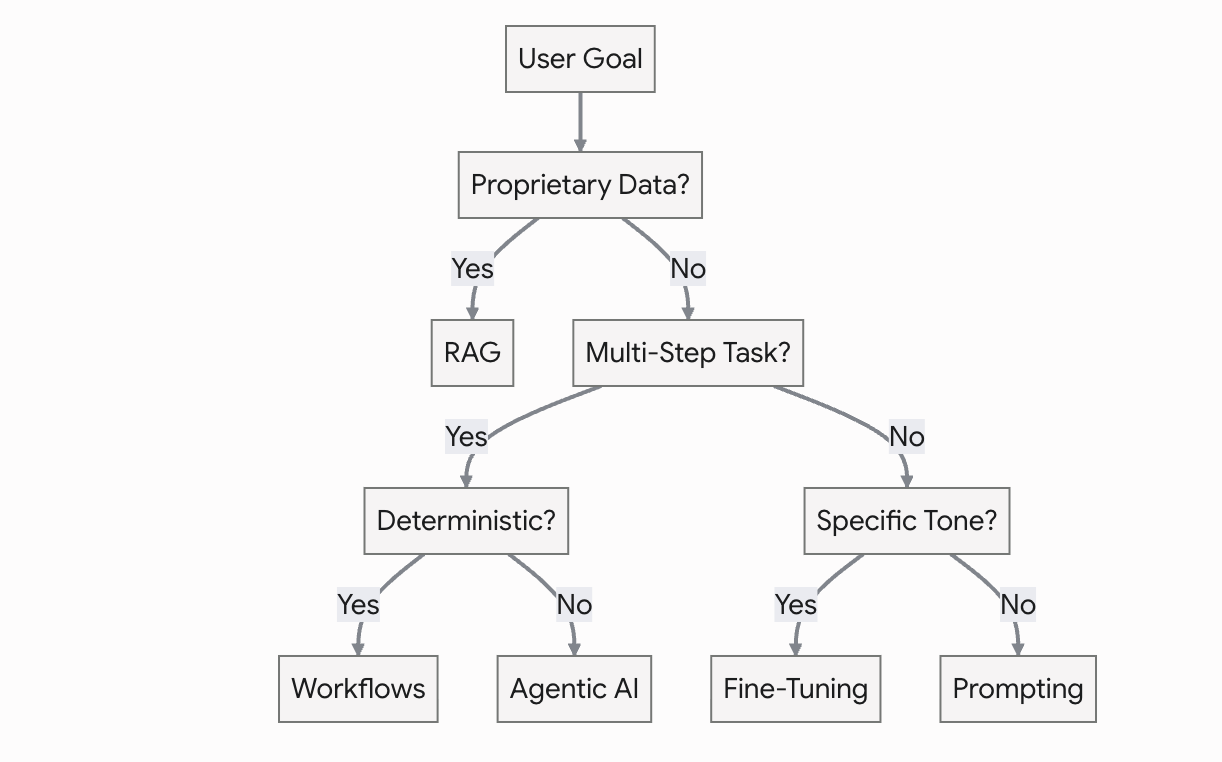
- Is it a simple, isolated task? (e.g., summarizing a block of text) → Use Stateless Prompting.
- Does the model need to know facts that aren't in its training data? → Build a RAG pipeline.
- Does the task require multiple steps, but you need guaranteed, predictable execution? (e.g., standard data extraction pipelines) → Build Workflow Orchestration. Workflows give you deterministic control, easy debugging, and clear audit trails.
- Is the problem dynamic, requiring the system to explore, use tools, and recover from its own errors? → Deploy an Agentic Architecture. Agents excel at open-ended exploration but require heavy monitoring and strict security boundaries.
- Does the model consistently fail to adopt a highly specific tone, language, or JSON structure, even with perfect prompting? → Invest in a Fine-Tuning pipeline. Remember: fine-tuning is for modifying behavior, not for injecting new facts.
The "best" AI architecture is the one that minimizes moving parts. Every time you move down that list, you are increasing your infrastructure footprint, your operational costs, and your security surface area. Start simple, prove the value, and only escalate to the next architectural tier when the current one provably fails to meet your constraints.

Indika Kodagoda
Indika Kodagoda is a Lead DevOps Engineer, AWS certification instructor, and the creator of CloudQubes. He specializes in cloud infrastructure, automation, and modern Ruby on Rails development. When he’s not deploying code or mentoring aspiring engineers, he’s usually enjoying nature and cycling local gravel paths.