
Beyond the LLM: How AWS, Azure, and GCP Handle Enterprise Agent Workloads
Planning your enterprise AI architecture? Compare 2026 AI services from AWS, Azure, and GCP to find the best fit for your security and infrastructure needs.
format_list_bulleted
Table of Contents
14 sections
expand_more
You've probably noticed a massive shift in how we build AI centric applications.
We're no longer just slapping a basic API call to an LLM onto a web backend and calling it a day. In 2026, the baseline has moved. We are deploying autonomous, multi-step agentic workflows that interact directly with our databases, trigger CI/CD pipelines, and make routing decisions on the fly.
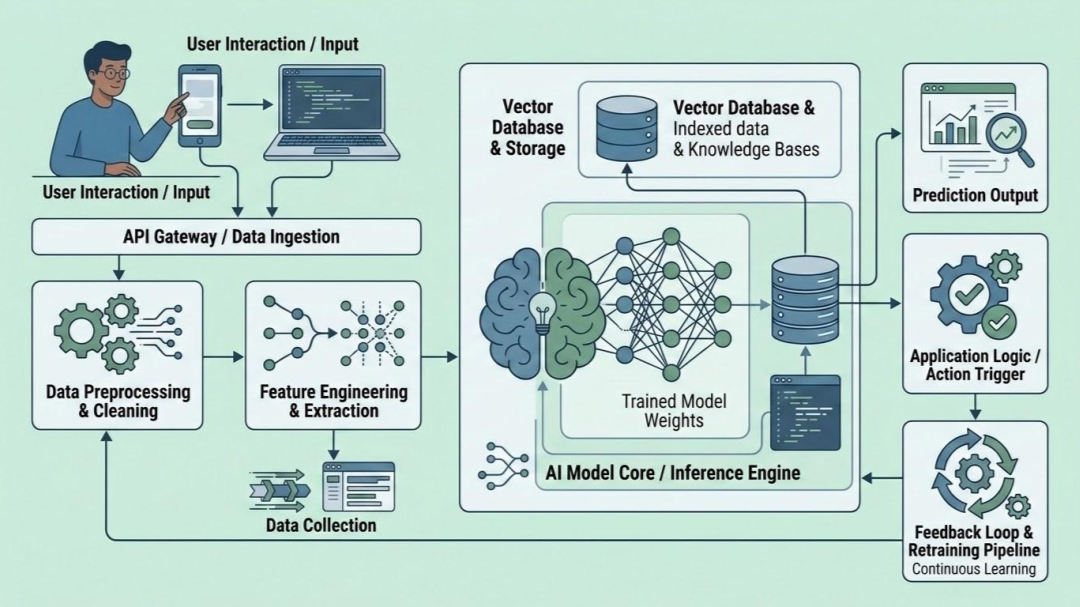
As these AI workloads become deeply embedded in our infrastructure, the "Big Three" cloud providers—AWS, Google Cloud (GCP), and Microsoft Azure—have drawn clear battle lines.
The interesting part? They aren't just competing on which model has the highest benchmark scores anymore. They are competing on how seamlessly these models integrate with your existing security perimeters, identity management, and operational pipelines.
If we zoom out, there is a distinct philosophical divide driving the cloud AI wars today:
- AWS: The modular, open marketplace championing absolute model flexibility.
- Google Cloud (GCP): The proprietary powerhouse betting everything on a deeply integrated, agent-first Gemini ecosystem.
- Microsoft Azure: The enterprise control plane locking down AI with strict corporate governance and an unbreakable OpenAI alliance.
If you are tasked with architecting these systems, the right choice depends less on the AI itself and entirely on your existing operational footprint. Let’s break down how AWS, GCP, and Azure actually handle the modern enterprise AI stack, so you can confidently route your next workload to the right platform.
AWS: The Modular Infrastructure & Open Marketplace#
When you look at how AWS approaches AI, their philosophy is crystal clear: they want to be the ultimate, neutral marketplace. They aren't trying to force you into a single proprietary model. Instead, they give you the Lego bricks to build exactly what you need, whether that means pulling an off-the-shelf LLM or training your own from scratch.
Let's break down the two main pillars of their AI stack and the silicon that powers it all.
Amazon Bedrock: The Orchestrator#
Think of Amazon Bedrock as your generative AI control plane. It operates on a strict Model-as-a-Service (MaaS) philosophy. Instead of dealing with the headache of hosting massive models yourself, Bedrock gives you a single, unified API to access the best foundation models in the world—including Anthropic's Claude, Meta's Llama, Mistral, and Amazon's own Nova family.
But Bedrock in 2026 is way more than just an API gateway. The real game-changer is Bedrock AgentCore. If you want to build autonomous agents that can actually do things—like securely query your proprietary data using RAG (Retrieval-Augmented Generation), trigger Lambda functions, or update a database—AgentCore handles the complex orchestration and multi-step reasoning. It allows you to build these agentic workflows while keeping all your data safely inside your own network boundaries.
Amazon SageMaker AI: The Industrial Workbench#
While Bedrock is for teams who want to consume models, Amazon SageMaker AI is for teams that demand "Model Sovereignty." This is where you go when you need to own the actual model weights, fine-tune deeply, or run highly custom machine learning workloads.
SageMaker has always been the industrial-grade workbench for ML engineers, but it historically felt a bit isolated from the rest of the data stack. Recently, AWS rolled out SageMaker Unified Studio, which beautifully bridges the gap between your data engineers and your ML ops teams. It brings your data lakes, visual ETL pipelines, and machine learning development into one cohesive environment, making it much easier to move from raw data to a deployed model.
The Infrastructure Edge: Trainium & Inferentia#
Underneath it all, AWS is playing a massive long game with custom silicon. If you are operating at scale, relying entirely on standard GPUs can absolutely blow up your cloud bill. AWS built their own AI-specific chips—Trainium for training models and Inferentia for running them. These accelerators are specifically designed to drive down the cost of deep learning workloads while maintaining high performance.
In short: if you value architectural flexibility, want to avoid vendor lock-in, and need strict control over your infrastructure components, AWS provides the most modular AI toolkit on the market today.
Google Cloud (GCP): The Gemini Agent Ecosystem#
If AWS is an open hardware store where you buy the parts to build your own tools, Google Cloud is a specialized workshop where all the tools are custom-built to work perfectly together. GCP has drawn a massive line in the sand: they aren't just selling you models; they are selling you an entire ecosystem deeply optimized around their Gemini architecture.
Recently, we saw GCP consolidate their fragmented AI offerings, evolving Vertex AI into what is now the Gemini Enterprise Agent Platform. It’s a clear signal that Google believes the future isn't just chatting with LLMs—it’s about deploying autonomous agents that can execute complex, multi-day tasks.
Here is how their highly integrated stack breaks down.
The Agent Development Kit (ADK) & Agent Studio#
GCP recognizes that you have different teams building AI, and they’ve created two distinct entry points.
For the hardcore engineering teams, the Agent Development Kit (ADK) is a code-first powerhouse. It’s designed to handle massive scale, allowing you to process trillions of tokens through the Gemini infrastructure directly within your code base.
On the flip side, they introduced Agent Studio, a low-code visual builder. It allows product managers or business analysts to rapidly prototype and deploy AI agents without writing complex integration logic. What makes Agent Studio impressive is that it isn't just a toy; it connects directly to the same robust infrastructure the ADK uses.
State & Memory: The Game Changer#
This is where GCP has built one of the most significant architectural differentiators in the cloud AI space right now: the Memory Bank and multi-day Agent Runtime.
Historically, LLMs are stateless. Every time you talk to them, they forget everything that happened previously unless you manually feed the entire context back into the prompt. That is a nightmare for long-running workflows. GCP's Memory Bank solves this by giving agents a persistent, managed memory. An agent can start a task on Monday, run into an error, wait for a human to review it on Tuesday, and seamlessly pick the task back up on Wednesday with all of its context intact.
Identity and Secure Routing#
When you have agents running autonomously for days, security becomes a massive headache. You can't just hand an AI bot a generic API key and hope for the best.
GCP approaches this with Agent Identity, assigning cryptographic IDs to specific agents. This means an agent navigating your infrastructure operates under strict IAM (Identity and Access Management) rules, just like a human engineer would. Furthermore, the Agent Gateway acts as a secure router, ensuring that when an agent reaches out to a third-party tool or an internal database, the connection is authenticated, logged, and compliant.
In short: GCP is the platform to choose if you are building complex, long-running agentic workflows and you want the infrastructure to handle the heavy lifting of state, memory, and routing natively.
Microsoft Azure: The Enterprise Control Plane#
While AWS builds for the infrastructure engineer and GCP builds for the AI researcher, Microsoft Azure is building for the CISO and the Enterprise Architect. In 2026, Azure’s AI strategy is defined by two massive pillars: its exclusive alliance with OpenAI and its relentless focus on corporate governance.
If you are deploying AI into an environment that is already heavily regulated or heavily invested in the Microsoft ecosystem, Azure is the path of least resistance.
Microsoft Foundry: The Unified AI Factory#
Azure recently consolidated its fragmented AI tools (like Azure AI Studio) into a single, massive control plane called Microsoft Foundry. Foundry isn't just an API endpoint; it’s an end-to-end "factory" designed to take AI agents from local experiments all the way to production systems.
While Azure is famous for being the exclusive cloud provider for the latest OpenAI models (like the GPT-5 family), Foundry is not a walled garden. They have adopted a more marketplace-like approach, giving developers access to over 11,000 models, including Claude, Mistral, and DeepSeek, all governed under the same Azure SLAs.
The Microsoft Agent Framework#
To compete with Google's agent-driven ecosystem, Microsoft reached GA (General Availability) on the Microsoft Agent Framework (MAF) in April 2026.
MAF is an open-source SDK that merges the best parts of earlier tools like AutoGen and Semantic Kernel. It provides a clean, unified programming model for building multi-agent workflows in Python or .NET. The killer feature for cloud engineers here is Hosted Agents. You can write an agent locally using MAF, and then deploy it directly onto Foundry's managed infrastructure. Foundry automatically handles the messy parts of production: spinning up isolated sandbox VMs for the agent, scaling to zero when idle, and maintaining a persistent filesystem so the agent remembers what it was doing across sessions.
Identity, Security, and "Shadow AI"#
This is where Azure truly separates itself from AWS and GCP. Foundry treats AI agents exactly like human employees.
Instead of passing around vulnerable API keys, every agent deployed in Foundry is assigned a Microsoft Entra Agent ID. This means an agent navigating your databases is bound by the exact same Active Directory permissions, conditional access policies, and audit logs as a human engineer.
Furthermore, Foundry natively integrates with Microsoft Purview to prevent data leakage and Microsoft Defender to block AI-specific attacks, like prompt injections or malicious tool usage, at runtime. For an enterprise IT team terrified of "Shadow AI" running amok in their network, Foundry's centralized Agent Registry provides a single dashboard to monitor, govern, and enforce compliance across every single AI workload in the company.
Architectural Comparison: How to Choose#
When it comes to routing workloads in 2026, the decision should rarely be based on which foundation model scored highest on a benchmark last week. The defining question is: Which platform's operational primitives (identity, networking, compliance) align with your existing architecture?
Here is the conceptual breakdown:
| Evaluation Concept | AWS Strategy | GCP Strategy | Azure Strategy |
|---|---|---|---|
| Model Philosophy | The Neutral Sandbox: Broadest third-party catalog (Claude, Llama, Mistral) under a single contract. | The Gemini Engine: Deeply optimized for Google's proprietary multimodal Gemini models. | The OpenAI Enterprise: Exclusive OpenAI (GPT/o-series) access wrapped in corporate governance. |
| Agent State & Memory | Developer-managed state or Bedrock AgentCore orchestration. | Native Agent Memory Bank for multi-day, persistent state management. | Foundry IQ, grounding agents deeply in enterprise data lakes (like SharePoint and OneLake). |
| Identity & Security | AWS IAM and VPC isolation; deeply native to standard cloud engineering practices. | Agent Identity (Cryptographic) and Workspace Data Loss Prevention (DLP). | Microsoft Entra ID assigns agents the same Active Directory permissions as human employees. |
| Best Fit For... | Polyglot architectures, cost-optimized custom models, and teams wanting model portability. | Deep Google Workspace integration, multimodal AI, and long-running autonomous agents. | Strict corporate compliance, CISO approval, and Microsoft ecosystem (M365) integration. |
Conclusion: The Reality of the Cloud AI Wars#
If there is one takeaway for cloud engineers in 2026, it is this: You are not choosing an AI model; you are choosing an operational boundary.
AWS Bedrock, Google's Gemini Agent Platform, and Microsoft Foundry have all matured far beyond simple model-hosting services. They are full-stack development ecosystems. The platform that hides its data egress costs, requires you to reinvent your identity management, or forces your security team into unfamiliar audit tools is the platform that will kill your AI program before it reaches production.
If your data lake lives in S3 and your team breathes IAM policies, AWS Bedrock is your path of least resistance. If you are building complex, long-running agents that need to natively read Gmail and parse Google Drive documents, fighting against GCP's integrated architecture is a mistake. And if your CISO demands that every line of code answers to Microsoft Entra ID and Purview, Microsoft Foundry is the only platform that will pass your compliance review without a six-month fight.
The "best" AI cloud doesn't exist. There is only the best AI cloud for your specific infrastructure. Architect accordingly.

Indika Kodagoda
Indika Kodagoda is a Lead DevOps Engineer, AWS certification instructor, and the creator of CloudQubes. He specializes in cloud infrastructure, automation, and modern Ruby on Rails development. When he’s not deploying code or mentoring aspiring engineers, he’s usually enjoying nature and cycling local gravel paths.