
Beyond the Chatbox: The Rise of Agentic AI and What it Means for the Cloud
Explore the 2026 agentic AI landscape with CloudQubes. Learn how autonomous AI agents are shifting DevOps from automation to autonomy, altering cloud resource consumption, and changing infrastructure security.
format_list_bulleted
Table of Contents
6 sections
expand_more
Suffering from AI fatigue?
You are not alone. We have been inundated with chatboxes, writing assistants, and summary generators.
But beneath the marketing noise, a quiet, monumental shift is happening in how software is architected and deployed.
We are rapidly moving away from the "prompt-and-response" era. The tech world is shifting from software you use to software you hire.
Welcome to the era of Agentic AI.
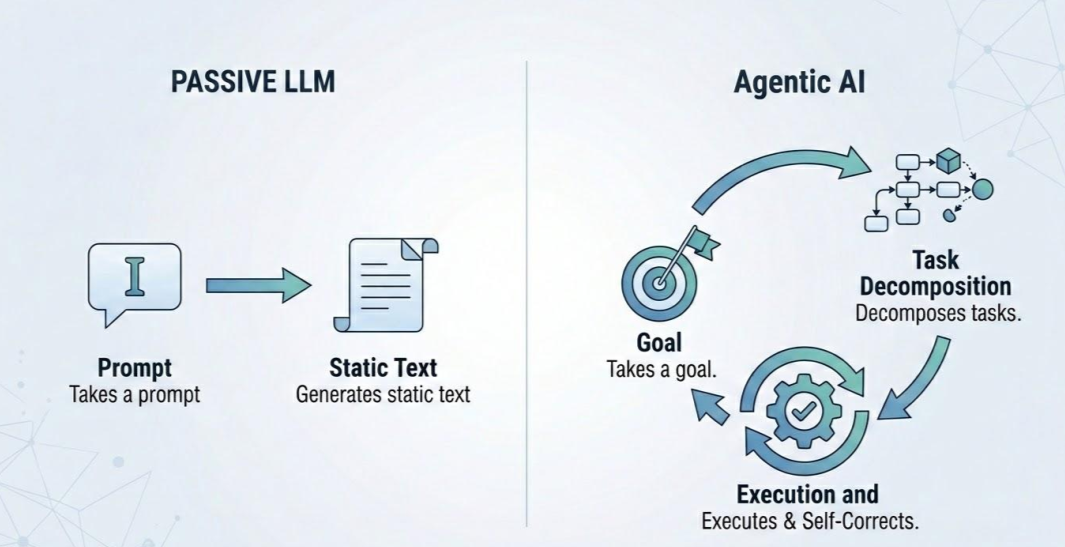
Until recently, our interactions with Large Language Models (LLMs) were transactional and heavily dependent on human steering. You typed a prompt, the model generated an answer, and if it missed the mark, you typed another prompt. The human remained the primary cognitive engine, doing the heavy lifting of planning, debugging, and stitching workflows together.
Agentic systems fundamentally flip this dynamic. An AI agent is not a chatbot; it is an autonomous system. Give it a high-level goal—such as "Migrate this microservice to a new cloud provider and write the integration tests"—and it doesn’t just tell you how to do it. It breaks the objective into a series of logical steps, spins up specialized sub-agents, writes the code, spins up a sandbox environment to test its work, diagnoses its own errors, and refactors until the job is done.
This leap from passive assistance to proactive autonomy has been unlocked by three core shifts in late 2025 and 2026: drastically lower inference costs, massive context windows that allow systems to grasp entire software repositories at once, and advanced reasoning architectures capable of deep "chain-of-thought" reflection.
For software teams, this is more than an impressive trick—it represents a fundamental re-architecting of cloud consumption, DevOps engineering, and infrastructure security. To understand where the industry is heading, we have to look past the conversational interface and dive into how these autonomous systems actually think, act, and execute.
The Architecture of an Agent: How They Think and Act#
To understand why agentic systems are so powerful—and why they are fundamentally different from standard LLMs—you have to look at the surrounding architecture.
An LLM on its own is just a reasoning engine. It has no memory of what happened yesterday, no way to execute code, and no ability to course-correct if it makes a mistake. An agentic system wraps that reasoning engine in a continuous control loop, often referred to as the Plan-Act-Observe-Adjust cycle.
Before diving into the specific components, this quick visual overview breaks down how these systems move from passive generation to autonomous action:
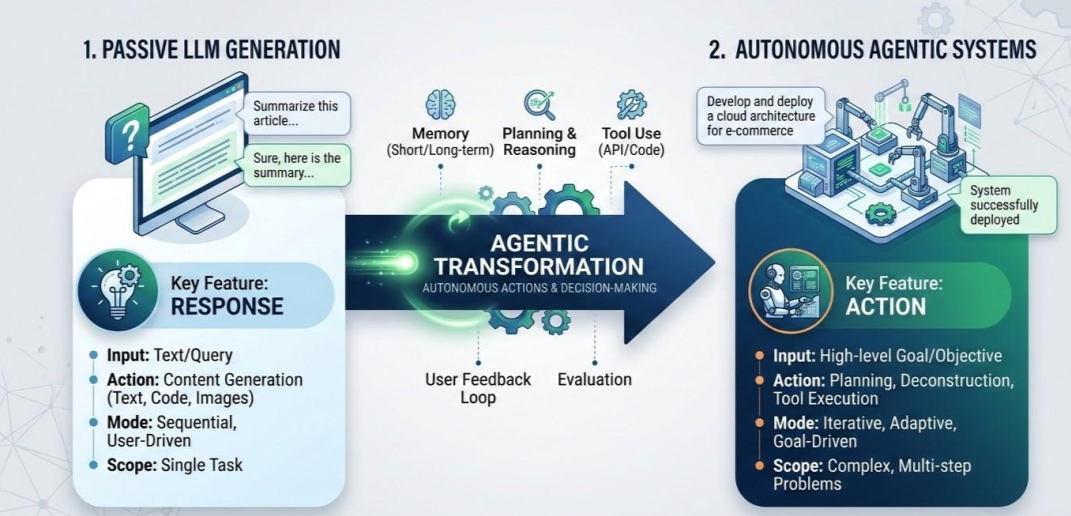
Key insight: The true intelligence of an agentic system doesn't just come from the size of its language model; it comes from the robustness of the orchestration layer surrounding it.
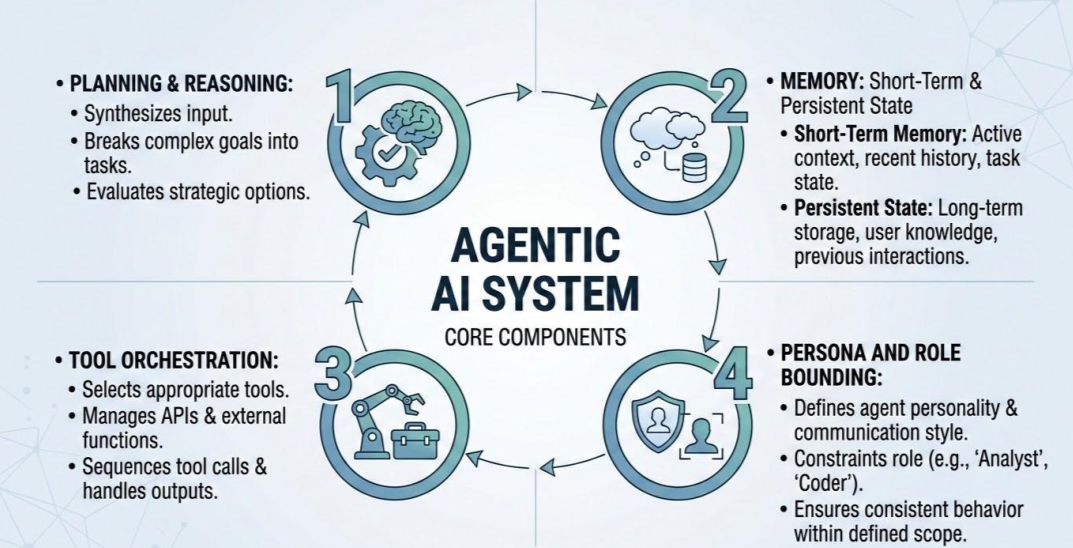
To build an autonomous worker that can survive in a production cloud environment, developers rely on four architectural pillars:
###
- Planning & Reasoning
If you ask a standard model to "migrate this database," it will spit out a generic tutorial. If you give the same goal to an agent, the planning layer intercepts the request and decomposes it into an executable graph of sub-tasks.
Modern agents use patterns like ReAct (Reason + Act) and Reflection. Before writing a line of code, the agent creates a step-by-step plan. As it executes, it constantly evaluates its own progress against the plan. If an API call fails or a script throws an error, the agent's reasoning layer pauses, reads the error logs, adjusts the plan, and tries a new approach without needing human intervention.
###
- Memory: Short-Term vs. Persistent State
A major limitation of early LLMs was their statelessness. Agentic architectures solve this through layered memory systems:
- Working (Short-Term) Memory: The agent's immediate "scratchpad" for an active session. It holds the current goal, recent tool outputs, and the chain of thought. Context window management is critical here to prevent the agent from getting confused by bloated error logs.
- Persistent (Long-Term) Memory: Stored externally, typically in a Vector Database or Knowledge Graph. This allows an agent to recall how a similar problem was solved three weeks ago, retain user preferences, and maintain continuity across multiple independent sessions.
###
- Tool Orchestration
Planning and memory make an agent smart, but tools make it useful. This is the interface where the AI touches your infrastructure.
Instead of just generating text, the agent outputs structured data (like JSON) that triggers external systems. A well-designed agent can execute Python in a secure sandbox, query a PostgreSQL database, open pull requests in GitHub, or provision AWS resources via Terraform. The orchestration layer handles the complex handshakes, ensuring the agent adheres to API rate limits, validates inputs against a strict schema, and safely handles timeouts.
###
- Persona and Role Bounding
In a complex multi-agent system, you don't just deploy generic "smart" bots. You design specialized roles.
The Persona pillar defines the behavioral constraints, tone, and decision boundaries of an agent. For example, a system migrating legacy code might utilize three distinct personas:
The Planner: Maps out the migration strategy.
The Implementer: Writes and refactors the code.
The Verifier: A strict, security-focused agent that audits the implementer's code and refuses to let it pass if it detects vulnerabilities.
By bounding agents into distinct personas, organizations prevent scope creep, reduce hallucinations, and ensure that sensitive operations always hit a "Human-in-the-Loop" (HITL) approval gate before execution.
Mapping the Current Landscape#
If 2024 was the year of the chatbot and 2025 was the year of the agent prototype, mid-2026 is defined by production-grade autonomy. We are past the point of simple web-scrapers; today’s market is saturated with platforms that manage complex, multi-day workflows.
However, "agentic AI" has become a heavily overloaded marketing term. To navigate this ecosystem, it helps to categorize the tools not by what underlying model they use, but by how they integrate into your existing workflows. The landscape breaks down into four primary tiers:
###
- Orchestration Frameworks (The Developer's Primitives)
These are the underlying code libraries and SDKs that engineers use to build custom, multi-agent systems from scratch. If you want total control over state management, loops, and custom tool integrations, this is where you live.
- LangGraph: The current industry standard for deterministic, graph-based orchestration. It excels in environments where you need strict control over the execution path and robust "Human-in-the-Loop" (HITL) approval gates.
- CrewAI: Takes a role-playing approach. You define agents with specific personas (e.g., "Senior QA Engineer," "Database Architect") and watch them collaborate to solve complex problems. It is incredibly fast for prototyping multi-agent crews.
- Microsoft Agent Framework / AutoGen: The go-to for .NET and enterprise ecosystems, allowing robust multi-agent orchestration backed by Azure's security guardrails.
###
- AI-First IDEs & Dev Tools (The Human-AI Pair)
These tools bring agentic capabilities directly to the developer's local environment. The human remains in the driver's seat, but the IDE acts as an autonomous pair programmer capable of deep, cross-file refactoring.
- Cursor: The dominant AI-first editor. Its "Agent Mode" can autonomously debug complex tracebacks, write integration tests, and implement new features while contextually understanding your entire repository.
- Windsurf: Features an orchestration engine called Cascade that retains deep, persistent memory of your project's architecture across multiple coding sessions.
- Claude Code: A terminal-native agent that operates directly from your command line, perfect for developers who want agentic reasoning without leaving their custom terminal configurations.
###
- Agent-First Environments (Mission Control)
This is the newest and perhaps most disruptive category. Instead of writing code alongside an AI, you act as a manager orchestrating a team of autonomous AI workers.
- Google Antigravity: A highly capable agent-first environment designed for rapid prototyping and multi-agent task execution.
- Intent: Takes a "living spec" approach. An orchestrator agent writes a technical specification, implementer agents build the code in parallel, and verifier agents test it—creating a highly auditable, compliance-ready loop.
- Eigent: An open-source alternative focused heavily on local deployments and data sovereignty, ensuring your autonomous workflows don't leak proprietary logic to external APIs.
###
- Enterprise & Hybrid Platforms (The Business Engine)
These platforms merge agentic reasoning with traditional Robotic Process Automation (RPA) and enterprise integrations to automate cross-platform business workflows.
- Gemini Enterprise Agent Platform: Google Cloud’s comprehensive suite for deploying agents grounded in enterprise data, tightly integrated with Google Workspace and Cloud infrastructure.
- Automation Anywhere / UiPath: The legacy RPA giants have successfully pivoted, injecting agentic reasoning layers into their platforms to handle unstructured data, unexpected UI changes, and complex decision-making across legacy systems.
Landscape Summary Matrix#
| Category | Primary Value Proposition | Control Level | Example Tools |
|---|---|---|---|
| Orchestration Frameworks | Build custom, persistent agentic logic from scratch. | High (Code-first) | LangGraph, CrewAI, MS Agent Framework |
| AI-First IDEs | Deep repository context and autonomous pair programming. | Medium (Human-driven) | Cursor, Windsurf, Claude Code |
| Agent-First Environments | Manage parallel AI workers like a software engineering team. | Low (Managerial) | Antigravity, Intent, Eigent |
| Enterprise Platforms | Automate complex business tasks across disparate SaaS apps. | Variable (No-code to Pro) | Gemini Agent, Automation Anywhere |
The Strategic Impact on Cloud Infrastructure#
For cloud architects and engineering leaders, the shift toward agentic AI is not just a software trend—it is an infrastructure reckoning.
Over the last decade, DevOps focused heavily on automation: writing scripts to make predictable systems run faster. However, traditional automation is brittle. If a pipeline encounters an edge case you didn't explicitly write a rule for, it breaks. Agentic AI moves us from automation to autonomy. Agents don't just execute a script; they read the error log, deduce the root cause, adapt to the new state, and execute a fix.
This transition fundamentally alters how cloud environments are provisioned, consumed, and secured.
###
- Autonomous DevOps: The End of "Pipeline Chores"
The days of humans hand-writing thousands of lines of YAML configurations, Dockerfiles, and Terraform modules are numbered. We are seeing the rapid rise of "Agentic Deployment Platforms."
Instead of building a rigid CI/CD pipeline, developers push code to a repository, and the autonomous agent takes over. The agent introspects the codebase, identifies the framework, provisions the necessary compute and database resources (e.g., spinning up an AWS RDS instance and configuring the VPC), handles the build, and monitors the live URL. If a health check fails during deployment, the agent autonomously reads the telemetry, diagnoses the failure, and rolls back—all without paging an SRE at 2:00 AM.
###
- A Paradigm Shift in Cloud Resource Consumption
Standard user-facing AI applications (like chatbots) generate spike-heavy traffic. Compute is consumed only when a human presses "Submit."
Agentic workflows flip this model. Multi-agent systems run continuously in the background, entering persistent loops of reflection, web scraping, and data processing. For cloud platforms, this means:
- Sustained Inference Loads: Moving from burst compute to constant, background token generation.
- The Rise of FinOps Agents: As autonomous agents spin up sub-agents and cloud resources to solve problems, token and compute costs can spiral. In response, organizations are deploying specialized FinOps agents—autonomous watchdogs that actively right-size instances, orchestrate spot instances, and optimize compute loads in real-time to prevent AI-driven budget overruns.
###
- Agentic Security and The New "Control Problem"
Handing the keys to your cloud infrastructure over to an AI agent is a terrifying prospect for any CISO. The primary security challenge of 2026 is no longer just defending against external threats, but managing the "blast radius" of internal, autonomous workers.
- The Explosion of Non-Human Identities: For every human developer, there may soon be a dozen autonomous agents operating in your environment. Each of these agents needs an identity, highly scoped IAM permissions, and an auditable trail of actions.
- Autonomous DevSecOps: On the defensive side, security is becoming agentic. Instead of passively scanning for vulnerabilities and creating a ticket for a human to fix, security agents actively monitor runtime behavior, detect anomalous API calls, write the patch for the vulnerability, and open a Pull Request for human approval.
- Human-in-the-Loop (HITL) Guardrails: To mitigate catastrophic errors (like an agent deciding to drop a production database to "fix" a schema issue), modern infrastructure requires strict governance layers. Low-risk actions (restarting a container) can be fully autonomous, while high-risk actions are hard-coded to halt and require human authorization.
The Reality Check: You cannot run agentic workflows safely on top of messy infrastructure. If your internal documentation is outdated and your IAM policies are overly broad, an autonomous agent will simply execute bad processes—and create security risks—at machine speed.
Challenges: The Reality Check of Autonomy#
While the potential of agentic AI is staggering, implementing it in production requires a heavy dose of realism. Moving from a deterministic codebase to a probabilistic agentic system introduces a brand new set of operational challenges that engineering teams must prepare to face.
###
- The Infinite Loop (and Exploding Token Costs)
In a traditional software loop, if code fails, it throws an error and halts. When an agent encounters an unexpected error, its instinct is to fix it. It might write a patch, run the code again, encounter a new error, write another patch, and repeat.
If left unmonitored, agents can fall into "hallucination loops"—spending hours autonomously trying to solve an impossible or poorly defined problem. Because every single attempt requires calling an LLM API, an unmonitored agentic loop can burn through thousands of dollars in token costs in a single afternoon. Implementing maximum iteration caps and strict cost-per-task budgets is non-negotiable.
###
- The Determinism Problem
Enterprise software relies on predictability. If a user clicks a button, the system should behave exactly the same way every time. Agents, by their very nature, are non-deterministic. Give an agent the exact same goal three times, and it may choose three entirely different execution paths to get there.
This makes testing, QA, and debugging incredibly difficult. If an agent introduces a subtle bug into an infrastructure configuration, tracing the "why" requires auditing the agent’s entire cognitive chain-of-thought history, not just reviewing static code.
###
- The Trust Threshold
The biggest barrier to agentic adoption isn't technical—it’s psychological. Are you willing to let an AI autonomously deploy code to a production environment handling millions of live users?
For most enterprises right now, the answer is no. This has led to the design of strict "Human-in-the-Loop" (HITL) frameworks. Agents operate inside a heavily sandboxed staging environment, and a human engineer must manually review and hit "Approve" before any changes are merged into the main production branch.
The Way Forward#
The rise of agentic AI does not spell the end of the software engineer or the cloud architect. Instead, it signals a fundamental evolution in their day-to-day responsibilities.
We are moving away from an era where engineers spend 70% of their time on "digital plumbing"—writing boilerplate code, debugging configuration files, and managing repetitive infrastructure tasks. In the agentic era, humans step into the role of the Orchestrator. Your job will be to define the system specifications, set the architectural boundaries, design the guardrails, and manage teams of autonomous digital workers.
For companies looking to maintain a competitive edge, the path forward is clear:
- Audit your data and docs: Agents are only as good as the context they are given. Clean up your internal repositories and API documentation today.
- Experiment safely: Start deploying agentic pair-programmers or staging-bound DevOps agents to let your team get comfortable with non-deterministic software.
- Build the guardrails first: Focus on IAM scoping, network isolation, and approval gates before letting agents touch critical systems.
The autonomous cloud is no longer a science fiction concept. The tools are here, the runtime environments are ready, and the landscape is shifting rapidly. The only question left is how quickly your organization will adapt to managing this new digital workforce.

Indika Kodagoda
Indika Kodagoda is a Lead DevOps Engineer, AWS certification instructor, and the creator of CloudQubes. He specializes in cloud infrastructure, automation, and modern Ruby on Rails development. When he’s not deploying code or mentoring aspiring engineers, he’s usually enjoying nature and cycling local gravel paths.