menu
A guide to cloud certifications
- Chapter 1: What is DevOps? What is Cloud?
- Chapter 2: Who is This Book For?
- Chapter 3: The Big Three Cloud Providers
- Chapter 4: Foundational Certifications (The Optional First Step)
- Chapter 5: AWS Certification Path for DevOps - The Associate-Level Foundation
- Chapter 6: The Goal: AWS Certified DevOps Engineer – Professional (DOP-C02)
- Chapter 7: Other Valuable AWS Certs
A guide to cloud certifications
Chapter 5: AWS Certification Path for DevOps - The Associate-Level Foundation
Welcome to the real starting line.
If the Foundational exams (like Cloud Practitioner) are the "Intro to University," the Associate exams are your core major. This is where the training wheels come off. You will be expected to know not just what a service is, but how to configure it, secure it, and fix it when it breaks.
For an aspiring DevOps engineer focusing on AWS, this is the most critical phase of your early career. You cannot build a skyscraper if you don't know how concrete works.
Let’s look at your options.
Why You Must Start Here
You might be thinking, "I want to be a DevOps Engineer. Why don't I just skip to the DevOps Professional exam?"
Two reasons:
- Difficulty: The DevOps Professional exam is widely considered one of the hardest IT certifications in existence. It assumes you already know the Associate-level material inside out. Attempting it without this foundation is a recipe for failure.
- Context: DevOps is about automating infrastructure. You cannot automate what you do not understand. You need to know how to manually architect a secure Virtual Private Cloud (VPC) before you can write a Terraform script to build one automatically.
Option 1 (The Gold Standard): AWS Certified Solutions Architect – Associate (SAA-C03)
If you only take one certification in your entire life, make it this one.
The Solutions Architect – Associate (SAA) is the most popular and respected cloud certification for a reason. It forces you to understand how AWS fits together as a cohesive system.
- What It Covers:
- Networking: The "Holy Trinity" of AWS networking: VPCs, Subnets, and Route Tables. If you don't understand this, you don't understand the cloud.
- Compute & Storage: Deep dives into EC2 (servers) and S3 (object storage).
- Security: Identity and Access Management (IAM)—who is allowed to do what.
- High Availability: How to design systems that don't crash when a data center goes offline (Load Balancers, Auto Scaling Groups).
- Networking: The "Holy Trinity" of AWS networking: VPCs, Subnets, and Route Tables. If you don't understand this, you don't understand the cloud.
- Why It's Critical for DevOps:
- DevOps engineers are often asked to "fix the pipeline." But often, the pipeline isn't broken—the architecture is. The SAA exam gives you the architectural intuition to say, "The deployment failed because the Security Group on the private subnet doesn't allow traffic from the Load Balancer," rather than staring blankly at an error log.
- Recommendation: Start here. It is the perfect balance of breadth and depth.
Option 2 (The Alternatives): Developer or CloudOps (the recent replacement for SysOps)
While the SAA is the generalist king, there are two other Associate exams that target specific roles.
AWS Certified Developer – Associate (DVA-C02)
Don't let the name fool you—this isn't a Java or Python coding exam. It is an exam about using AWS services to run code.
- Focus: It goes very deep into "Serverless" technologies (Lambda, API Gateway, DynamoDB) and the native AWS developer tools (CodeCommit, CodeBuild, CodeDeploy, CodePipeline).
- DevOps Value: This exam is actually closer to the day-to-day work of a DevOps engineer than the Architect exam because it covers the CI/CD tools heavily. However, it skips the networking depth.
AWS Certified CloudOps Engineer – Associate (SOA-C03)
This is the new certification that AWS introduced quite recently (September, 2025) to replace the AWS Certified SysOps Administrator - Associate (SOA-C02) certification. So, if you've been planning to take the AWS SysOps certification exam, you cannot register for it anymore. Instead, you must take the CloudOps Engineer Associate (SOA-C03) exam.
This is the new certification that AWS introduced quite recently (September, 2025) to replace the AWS Certified SysOps Administrator - Associate (SOA-C02) certification. So, if you've been planning to take the AWS SysOps certification exam, you cannot register for it anymore. Instead, you must take the CloudOps Engineer Associate (SOA-C03) exam.
This is the "dark horse" of the group. It is notoriously difficult because it is very operational.
- Focus: Monitoring, auditing, troubleshooting, and remediation. It asks questions like "The server is slow; which metric in CloudWatch do you check?" or "You locked yourself out of an instance; how do you get back in?"
- DevOps Value: Highly relevant for the "Ops" side of DevOps, but often seen as harder to pass than the Architect exam due to its scenario-based questions.
Before 2023, the SysOps(SOA-C02) exam included practical labs. For some reason, AWS removed these practical labs limiting the exam to single and multi-choice questions similar to other associate examinations. The CloudOps engineer certification exam also do not include practical labs. But, there's a possibility that AWS will include practical labs to this exam in future.
Comparing the Associate Exams: Choosing Your Path
So, which one do you pick?
Here's a quick comparison of the AWS Associate certification.
Here's a quick comparison of the AWS Associate certification.
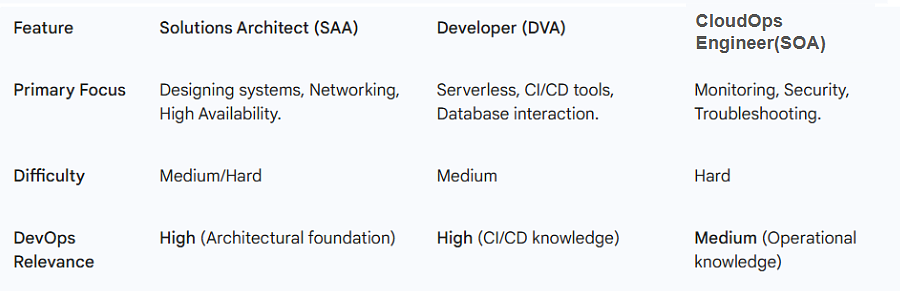
The Verdict
For 90% of people:
Start with the Solutions Architect – Associate (SAA-C03).
It provides the broad context you need. It is the foundation that the DevOps Professional exam builds upon.
It provides the broad context you need. It is the foundation that the DevOps Professional exam builds upon.
The "DevOps Specialist" Path:
If you have extra time, the ideal one-two punch is:
- Pass the Solutions Architect (SAA) to learn what to build.
- Pass the Developer Associate (DVA) to learn how to deploy it.
Once you have conquered the Associate level, you have earned your stripes. You understand the cloud. Now, it's time to learn how to automate it at scale.
Next up: The Boss Level. The AWS DevOps Engineer Professional.
This book is write-in-progress.
Come back in a few days to read the next chapter.
This book is write-in-progress.
Come back in a few days to read the next chapter.